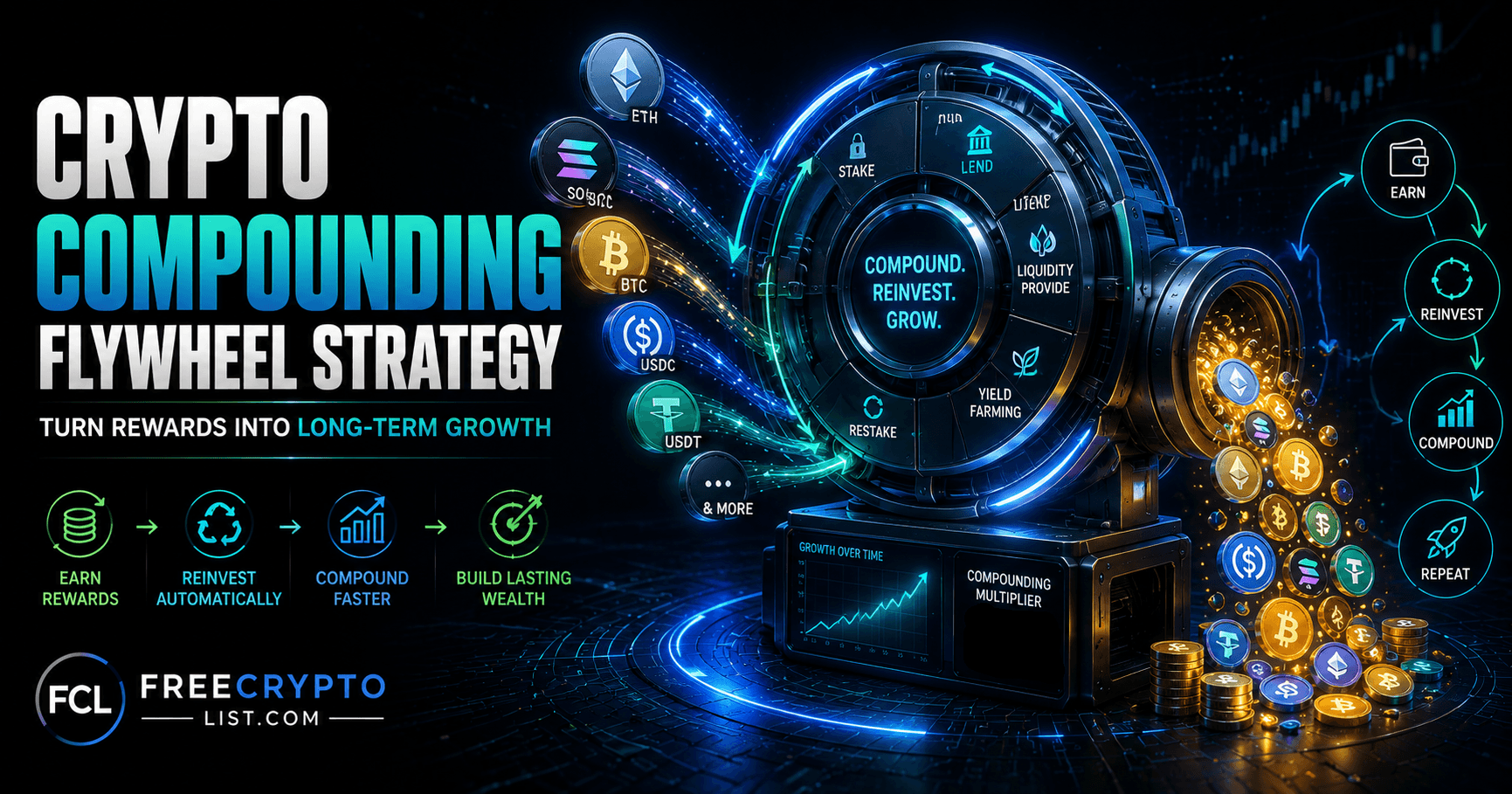
The Crypto Compounding Flywheel
How to Build a Self-Sustaining Crypto Position From Zero
Updated September 23, 2026
Most people think you need money to make money in crypto. You don’t.
What you need is a system. A way to take the small free crypto you can earn today – from faucets, airdrops, and surveys – and turn it into something that generates more crypto on its own, without ever adding new capital.
That system is what we call the Crypto Compounding Flywheel. It’s not a get-rich-quick scheme. It’s not theoretical. It’s a practical, step-by-step strategy that takes you from zero to a genuinely self-sustaining crypto position – using nothing but free opportunities, consistent effort, and the compounding mechanics that power the entire DeFi ecosystem.
This is the most important article on this site. Everything else here exists to support this strategy.
What Is a Flywheel?
A flywheel is a mechanical device – a heavy rotating wheel that stores energy. It takes significant effort to get it spinning initially, but once it’s moving it maintains momentum with minimal input. Each rotation makes the next one easier.
That’s exactly how this strategy works. The early stages require the most effort – collecting free crypto consistently, building a base, learning the mechanics. But once you’ve deployed your first liquid staking position, the flywheel starts spinning. Yields generate more crypto. More crypto generates more airdrops. More airdrops feed back into more yield. The cycle compounds.
A single asset can simultaneously generate staking rewards, liquidity fees, and additional incentives. Capital is increasingly reused across multiple protocols – this is the core mechanic the flywheel exploits.
The entry point is free. The compounding is real. The strategy just requires understanding the four steps.
The Four Steps
Step 1 – EARN: Build Your Base With Free Crypto
Every flywheel needs an initial push. For this strategy, that push comes entirely from free crypto – no purchase required.
There are three primary sources:
Faucets – platforms that pay small amounts of crypto for completing simple daily tasks. Not life-changing amounts, but consistent and cumulative. Cointiply, Fire Faucet, and Rollercoin are the most reliable options in 2026. Check out our full faucet reviews for detailed breakdowns.
Surveys and tasks – Freecash and Cointiply pay significantly more than faucets for sharing opinions, testing apps, and completing offers. A consistent daily routine across two or three platforms can realistically generate $30-100 per month.
Airdrops – the highest-potential free crypto source. Projects distribute tokens to early users, active DeFi participants, and community members. A single well-timed airdrop can be worth hundreds or thousands of dollars. Check our [Active Airdrops page – link pending] for current opportunities.
How long does Step 1 take?
This varies significantly based on effort and luck. A conservative estimate for reaching a meaningful amount to deploy in Step 2 is 1-3 months of consistent daily activity. The exact amount needed depends on the chain you target and gas fee levels – on Solana, even $20-50 worth of SOL is enough to begin. On Ethereum mainnet, you’d want more.
The key insight: you don’t wait until you have a large amount before starting Step 2. Start small. Bridge $10, liquid stake it, see how it works. The learning is part of the compounding.
Step 2 – BRIDGE & STACK: Move to a Productive Chain and Liquid Stake
Once you’ve accumulated some crypto – even a small amount – the next step is moving it to a chain where it can work for you. This means bridging and liquid staking.
Why bridging matters:
Most free crypto arrives as Bitcoin, Ethereum, or small amounts on various chains. To deploy it productively in DeFi you often need to move it to a chain with lower fees and active protocols. Solana, Arbitrum, and Base are the best options in 2026 for cost-effective DeFi participation.
Check out our How to Bridge Crypto guide for a full walkthrough.
Why liquid staking is the key unlock:
Liquid staking allows you to stake ETH via a protocol like Lido for stETH, then use stETH in other protocols for layered yield – staking rewards plus additional DeFi returns simultaneously.
This is the crucial difference between regular staking and the flywheel strategy. With regular staking, your crypto is locked – it earns yield but you can’t use it for anything else. With liquid staking, you receive a liquid staking token (LST) representing your staked position. That LST is what fuels Step 3.
A liquid staking protocol amplifies yield farming by letting users stake assets and still use a liquid derivative in DeFi – earning staking rewards plus the ability to deploy tokens into other yield strategies.
Key liquid staking options in 2026:
Lido (stETH) – stake ETH, receive stETH. Roughly 2-3.5% APY base (rates fluctuate – check current numbers on the protocol’s own dashboard before depositing), deployable across all major DeFi protocols
Rocket Pool (rETH) – decentralized ETH staking alternative, similar yield range to Lido with a more distributed validator set
Marinade Finance (mSOL) – leading Solana liquid staking protocol
aPriori (aprMON) – liquid staking on Monad, which launched mainnet in late 2025 and has become one of the more active new ecosystems since
Kintsu (sMON) – alternative Monad liquid staking. Some users have reported reliability issues – check community channels before using.
The gas reserve rule: Always keep some of the native chain token unstaked for gas fees. You need ETH to transact on Ethereum, SOL to transact on Solana. Never liquid stake 100% of your holdings – you’ll need gas to do anything with the LST you receive. See our full staking guide for details.
Step 3 – DEPLOY: Put Your LSTs to Work in DeFi
This is where the flywheel gains real momentum. Your liquid staking tokens are now productive assets that can be deployed across DeFi protocols to earn additional yield – on top of the base staking rewards already accumulating.
Yield farming in 2026 includes liquidity provision on DEXs, lending, and liquid staking. Rates vary constantly by protocol and market conditions – stablecoin strategies and blue-chip pairs both move in wide ranges depending on demand, so treat any specific number as a snapshot, not a promise.
The three main deployment strategies:
Lending – supply your LSTs to a lending protocol as collateral. You earn interest from borrowers while your base staking yield continues. This is the lowest risk deployment option and the best starting point for beginners.
Liquidity provision – deposit your LSTs alongside another asset into a DEX liquidity pool. You earn a share of every swap fee that occurs in that pool. Higher potential return than lending, but introduces impermanent loss risk if the two assets diverge significantly in price.
Yield aggregators – automated vault platforms compound your returns across multiple strategies, reinvesting earnings continuously without manual management, connecting dozens of protocols across many blockchains and rebalancing to maximize yield.
The airdrop bonus layer:
This is the part that most people miss entirely. By actively using DeFi protocols – lending, swapping, providing liquidity – you’re simultaneously building on-chain history that qualifies you for future protocol airdrops. Most protocols snapshot wallet activity over weeks or months, rewarding behaviors like swapping volume, providing liquidity, holding protocol NFTs, or participating in governance votes. The common thread: genuine usage, not wallet-farming.
In other words, Step 3 earns you yield AND positions you for Step 1 rewards on the next cycle. The flywheel feeds itself.
Realistic yield expectations for 2026:
Yields across native staking, liquid staking, and DeFi deployment shift constantly with market conditions – what’s true this month may not hold next month. As a rough starting point, combined yield from liquid staking plus DeFi deployment has historically landed somewhere in the high single digits to low double digits (annualized) for conservative strategies using established protocols, though this range moves. Always check current rates directly on the protocol before depositing rather than relying on any published number, including this one.
Step 4 – COMPOUND & REPEAT: Harvest and Reinvest
The final step closes the loop and turns a strategy into a flywheel. Regular harvesting of DeFi yields and newly earned airdrops, then feeding them back into Step 1 to restart the cycle.
There are two ways to compound:
Harvest and redeploy – claim your accumulated DeFi yields and add them back to your staking and liquidity positions, increasing your earning base for the next cycle. Capital is increasingly reused across multiple protocols – a single asset can simultaneously generate staking rewards, liquidity fees, and additional incentives.
Airdrop reinvestment – when new airdrop tokens land in your wallet, evaluate them honestly. Some are worth holding. Many are worth converting immediately to a more productive asset and redeploying into the flywheel. The question to ask: does this token have a clear use case and genuine adoption, or is it speculative noise?
Compounding frequency matters:
The more frequently you compound – reinvesting rewards back into productive positions – the faster the flywheel accelerates. Daily compounding is mathematically optimal but practically expensive in gas fees at small balances. Weekly or monthly compounding is the sweet spot for most users, balancing compounding benefit against transaction costs.
On chains with near-zero fees like Solana or Layer 2s like Arbitrum and Base, compounding more frequently makes sense. On Ethereum mainnet, wait until your accumulated rewards are large enough to justify the gas cost.
The Full Cycle – What This Looks Like in Practice
Here’s a concrete example of how the flywheel runs:
Month 1-2:
Collect free crypto daily from Cointiply, Freecash, and faucets. Claim a small airdrop from a Solana protocol you’ve been using. Combined: ~$40-80 worth of various crypto.
Month 2:
Bridge earnings to Solana. Liquid stake SOL via a Solana liquid staking protocol – receive the LST. Deposit it into a Solana lending protocol – earn additional yield on top of base staking. Cost: ~$2-3 in gas fees.
Month 3 onwards:
Weekly: collect faucet and survey earnings, add to position. Monthly: harvest lending yield, compound back into your LST position. Ongoing: DeFi activity qualifies you for new ecosystem airdrops. New airdrops received → converted → liquid staked → deployed → repeat.
Month 6:
Base position has grown through compounding. Multiple airdrop claims from protocols you’ve been genuinely using. Flywheel is spinning with minimal new input required.
This isn’t a prediction – it’s an illustration of the mechanics. Actual results vary enormously based on effort, market conditions, and airdrop luck. The point is the structure, not the specific numbers.
Risks to Understand Before You Start
The flywheel strategy is genuinely zero capital required – but it’s not zero risk. Here’s what to account for:
Smart contract risk – every DeFi protocol you interact with carries some risk of exploit or bug. Mitigate this by using only audited, established protocols and keeping individual positions to amounts you’re comfortable losing.
LST depeg risk – liquid staking tokens occasionally trade below the value of the underlying asset during market stress. This is usually temporary but worth understanding. Our guide on choosing validators covers this in detail.
Gas fee erosion – at very small balances, gas fees can consume a meaningful percentage of your earnings. Start on low-fee chains (Solana, Arbitrum, Base) and only move to Ethereum mainnet once your position is large enough to justify it.
Airdrop uncertainty – airdrops are not guaranteed. DeFi activity positions you for airdrops but doesn’t promise them. Treat any airdrop as a bonus on top of your yield earnings, not the primary return.
Tax obligations – staking rewards, airdrop tokens, and DeFi yield are typically taxable income in most jurisdictions. Track everything from day one. Our guide to tax-free earning strategies and our guide to reporting crypto taxes for US filers cover what you need to know.
Where to Start Today
The flywheel doesn’t require everything to be set up perfectly before you begin. Start with Step 1 and build from there.
Today: Sign up for Cointiply and Freecash – your daily earning foundation. Set up a crypto wallet if you haven’t already. Check the [Active Airdrops page – link pending] for current opportunities.
This week: Establish a daily routine – 20-30 minutes across your earning platforms. Read our bridge guide so you understand how to move crypto when you’re ready. Read our liquid staking guide to understand what you’re working toward.
This month: Bridge your first earnings to a productive chain. Make your first liquid staking deposit – even a small one. Start building on-chain history that qualifies you for future airdrops.
The flywheel starts spinning the moment you take the first step. It doesn’t matter how small that step is.
Conclusion
The Crypto Compounding Flywheel is the answer to the most common question we get: “I don’t have money to invest – how do I get started in crypto?”
You start by earning free crypto. You convert those earnings into a productive position. You deploy that position to earn more. And you reinvest to keep the cycle going.
No starting capital required. No complex trading strategies. No promises of overnight wealth. Just a systematic, compound strategy that gets more powerful with every rotation.
Everything on this site exists to support this flywheel – every faucet review, every airdrop listing, every how-to guide. Now you know why.
Start with Step 1 → and let the flywheel do the rest.
This article is for educational purposes only and does not constitute financial advice. DeFi protocols carry risk. Always do your own research before depositing funds into any protocol.
📖 Follow the full flywheel: Step 1 – Earn – Step 2 – Bridge – Liquid Stake – Best LST Protocols – Step 3 – What Is DeFi – Lend on Aave – Liquidity Pools – Step 3 and 4 – Yield Farming
📖 In This Section: How-To Guides Hub · Free Crypto Tools · Start Here
← Back to The Crypto Compounding Flywheel
Yes. Every dollar in this strategy originates from faucets, surveys, or airdrops – none of it requires buying crypto first. Gas fees are the only unavoidable cost, which is why starting on a low-fee chain like Solana or a Layer 2 matters more than the size of your initial balance.
Reaching a meaningful amount to deploy in Step 2 typically takes 1–3 months of consistent daily effort. The flywheel compounds slowly at first and accelerates as your base grows – most of the “boring” work happens early.
Liquid staking tokens carry smart contract risk and occasional depeg risk during market stress, same as any DeFi protocol. Established, well-audited options with years of track record are a safer starting point than newer, unproven protocols – which is why this strategy sticks to that category.
Always keep a small reserve of the native chain token unstaked before liquid staking. Starting on Solana or a Layer 2 like Arbitrum or Base keeps this reserve small – often just a few dollars – compared to Ethereum mainnet.
In most jurisdictions, yes – staking rewards, airdrop tokens, and DeFi yield are typically treated as taxable income when received. Track everything from day one rather than trying to reconstruct it later.
Solana, Arbitrum, or Base are the most practical starting points in 2026 because of low fees, which matters most while your balance is still small. Move to Ethereum mainnet only once your position has grown enough to absorb the higher gas costs.
Sources:
- Ethereum.org – Staking explained
- IRS – Digital assets guidance
← Back to Home