Cosmos Ecosystem Airdrop Guide 2026
How Staking ATOM Earns You Free Tokens on Autopilot
Updated October 18, 2026
Quick Stats
- Chain: Cosmos Hub
- Token: ATOM
- Strategy: Stake ATOM for staking rewards, with a chance of airdrops from new Cosmos projects
- Wallet: Keplr or Cosmostation
- Starting capital: Any amount of ATOM. More staked usually means larger airdrop allocations
- Risk level: Low to medium. An established chain (live since 2019), but ATOM’s price has fallen more than 95% from its peak
- Time required: About 30 minutes to set up, very little after that
Our Rating
| Category | Score | Notes |
|---|---|---|
| 💰 Potential Value | ⭐⭐ 2/5 | Osmosis, Celestia, Neutron and Dymension all rewarded ATOM stakers, but big staker airdrops have been rare since early 2024 |
| 🎯 Difficulty | ⭐⭐⭐⭐⭐ 5/5 | Simplest strategy on this site: stake and wait |
| ⏰ Time Required | ⭐⭐⭐⭐⭐ 5/5 | Near-zero ongoing effort once set up |
| 🛡️ Security Risk | ⭐⭐⭐⭐ 4/5 | The Hub itself has never been hacked, but September 2026 showed that problems on connected chains can still halt it |
| ✅ Legitimacy | ⭐⭐⭐⭐⭐ 5/5 | Cosmos projects have airdropped to ATOM stakers since 2021 |
| 📅 Longevity | ⭐⭐⭐ 3/5 | New Cosmos chains still launch, but the Hub stopped onboarding new Interchain Security chains in 2026, and fewer projects target ATOM stakers |
Signal or Noise? ⚠️ Mixed. Staking ATOM is a solid, low-effort way to earn staking rewards on a long-running chain. But if you’re staking only to catch airdrops, expectations need resetting: the golden era of 2021-2024, when big projects dropped tokens on ATOM stakers again and again, has cooled down a lot. Treat any airdrops as a bonus, not the reason to buy.
Not sure what these ratings mean? Read our full rating methodology →
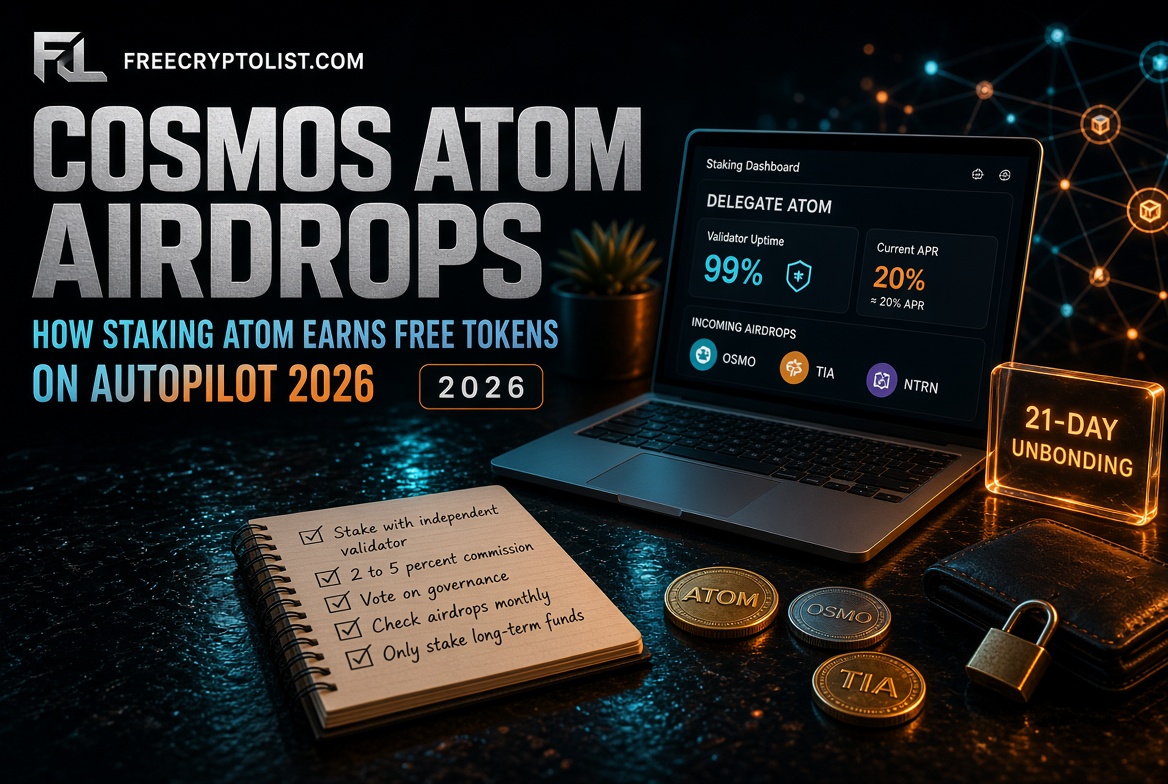
The short version: staking ATOM in Keplr or Cosmostation takes about 30 minutes, pays a staking reward of roughly 14-20% a year depending on the source (check the live rate in your wallet), and keeps you eligible for any airdrops that target ATOM stakers. Your ATOM is locked for 21 days when you unstake. The rewards are mostly new ATOM created by inflation, so they protect you from dilution more than they make you rich, and ATOM’s price has fallen hard. Airdrops still happen in Cosmos, but far less often than in the boom years.
This One Is Different
If you’ve read our Monad Ecosystem Guide or Solana Ecosystem Guide, you’ll notice this one has a different energy. Those guides are about active farming: logging in, making transactions, and building on-chain history. They reward steady effort.
The Cosmos approach is almost the opposite.
You stake ATOM once and leave it. When a new Cosmos project wants an engaged community, it can take a snapshot of active ATOM stakers and give them some of its tokens. Your wallet can receive tokens from projects you never signed up for. That happened dozens of times between 2021 and 2024.
If you want to set something up properly once and then mostly forget about it, this is your strategy. Just go in knowing that the airdrop side is slower than it used to be.
What Is Cosmos and Why Does It Airdrop?
Cosmos is one of the oldest blockchain ecosystems in crypto, built around one idea: blockchains should be able to talk to each other. Its Inter-Blockchain Communication protocol (IBC) connects more than 100 chains, and in 2025 it was extended to Ethereum. Connecting Solana is on Cosmos’s roadmap for late 2026.
ATOM is the native token of the Cosmos Hub, which has been live since 2019. It’s used for staking, governance, and securing the network.
The airdrop culture grew out of that structure. A new chain built with the Cosmos SDK needs early users who already understand the ecosystem. The easiest way to find them is a snapshot of ATOM stakers, people who are clearly committed for the long term.
The Track Record – What Has Actually Paid Out
Here are the best-known airdrops that went to ATOM stakers:
Osmosis (OSMO), 2021 – the biggest exchange in the Cosmos ecosystem airdropped to ATOM stakers at launch and became one of the most valuable Cosmos tokens.
Juno (JUNO), 2021, and Evmos (EVMOS), 2022 – more early airdrops that included ATOM stakers.
Neutron (NTRN), 2023 – the first chain secured by the Cosmos Hub’s validators under Interchain Security. It airdropped to ATOM stakers. Neutron later became an independent chain in 2025.
Celestia (TIA), 2023 – one of the most anticipated airdrops in crypto, shared between ATOM stakers, Osmosis stakers, and other groups.
Dymension (DYM), early 2024 – distributed to ATOM stakers, Celestia holders, IBC users, and others.
Since early 2024, large airdrops aimed at ATOM stakers have become rare. Smaller projects and loyalty campaigns still appear, but the stream of major drops has slowed a lot. That’s why the rating above dropped from where it was a year ago.
Where Things Stand in 2026
Staking rewards. ATOM’s staking reward is roughly 14% a year as of September 2026, with some trackers showing closer to 20%. The exact number depends on how much ATOM is staked and on your validator’s commission, so check the live rate in Keplr or Cosmostation. Remember what it is: mostly newly created ATOM. Staking keeps you from being diluted by inflation rather than giving you a pure profit.
Price. ATOM traded around $1.70-1.75 in early October 2026, more than 95% below its all-time high of about $44. A high staking rate doesn’t help much if the token keeps falling.
Big changes this year:
- Interchain Security wound down. In September 2026, the Gaia v28 upgrade removed Interchain Security for new consumer chains and cut the active validator set from 200 to 180. Neutron, the flagship Interchain Security chain, had already left in 2025 to become independent. In practice, the Hub is no longer adding chains that it secures, and those chains used to be a natural source of airdrops for stakers.
- The Neutron attack and Hub halt. On September 22, 2026, an attacker took over Neutron’s governance and seized control of contracts used by Astroport and other apps. About 1.73 million stolen ATOM was moved to the Cosmos Hub. Validators halted the Hub for about 24.5 hours, then used a one-time upgrade to move about 1.23 million of the stolen ATOM into a recovery wallet. Roughly 500,000 ATOM was swapped away before the halt and couldn’t be recovered. Cosmos Labs said the Hub itself wasn’t attacked and Hub users’ funds were unaffected. The halt and the validator intervention sparked debate about decentralization.
- Tokenomics redesign. Cosmos Labs is working on a redesign of ATOM’s economics, moving away from inflation toward fee-based value. If it passes governance, staking rewards could change.
- Real-world use. In October 2026, Wells Fargo said its tokenized deposit platform uses Cosmos ledger technology. That’s a sign the tech is used outside crypto, though it doesn’t directly reward ATOM stakers.
One Important Warning – The 21-Day Unbonding Period
When you unstake ATOM, it takes 21 days before your tokens are returned and can be moved again. During those 21 days, your ATOM earns nothing and can’t be sold.
That’s a deliberate design feature that keeps the network stable, not a scam. But it means two things:
First, only stake ATOM you’re comfortable not touching for three weeks at any time. Don’t stake money you might need in a hurry.
Second, it rewards long-term thinking. If you’re staking as a passive strategy with no plan to sell quickly, the unbonding period hardly matters. It only hurts if you try to trade in and out.
Validator Selection – The Detail That Matters
You don’t stake ATOM directly. You delegate it to a validator, who runs the infrastructure that secures the chain and passes rewards back to you minus a commission. Your ATOM never leaves your wallet’s control.
Validator choice matters for three reasons:
Commission – most validators charge around 5-10% of your rewards. Watch out for validators that have raised their commission sharply over time, and check again every few months.
Airdrop eligibility – some projects exclude stakers with big exchange validators like Coinbase, Binance, or Kraken from their snapshots. Delegating to an independent validator keeps you eligible for more airdrops, and it helps decentralize the network.
Staying in the active set – only the top 180 validators earn rewards. If your validator drops out, your stake stops earning until you move it. When the set shrank from 200 to 180 in September 2026, about 4.26 million ATOM started unbonding from validators that dropped out. Choose a validator ranked comfortably inside the top 180, and check on it now and then.
Both Keplr and Cosmostation show each validator’s commission, uptime, voting record, and rank. Our guide to choosing a validator covers what to look for in more detail.
How to Get Started
Step 1 – Get a Cosmos wallet
Keplr is the standard Cosmos wallet and works with almost every app in the ecosystem. Cosmostation is a solid alternative, especially on mobile. Write your recovery phrase on paper and keep it safe. New to self-custody? Start with our wallet setup guide.
Step 2 – Get some ATOM
Buy ATOM on an exchange like Coinbase or Kraken and withdraw it to your Cosmos wallet address (it starts with “cosmos1”). Send a small test amount first.
There’s no minimum. Any amount earns staking rewards and counts for airdrop snapshots. When airdrops are based on stake size, more ATOM means a bigger share, but don’t buy more than you’re comfortable holding through big price swings.
Step 3 – Delegate to a validator
Open the staking section in your wallet and pick a validator. Look for:
- A reasonable commission (around 5-10%)
- Uptime above 99%
- Active governance voting
- Comfortably inside the top 180
- Not run by a centralized exchange
Click Delegate, enter your amount, and confirm. You’re now staking. Keep a little ATOM unstaked to pay network fees.
Step 4 – Vote in governance
Some projects have used governance voting as an airdrop criterion. It takes two minutes and shows you’re an active participant. Check your wallet for open proposals now and then, and vote.
Step 5 – Claim your rewards and check for airdrops
Staking rewards build up and need to be claimed. You can claim them and re-stake them to compound. Check Cosmos Airdrops about once a month for claimable airdrops. Some have claim windows that expire.
Be careful with “airdrops” you didn’t expect. Cosmos wallets attract spam tokens and fake claim pages. A real airdrop never asks for your recovery phrase or a payment to unlock it. If a token shows up with a link telling you to claim on some site, treat it as a scam until proven otherwise. See our guides to honeypot airdrop tokens and receiving airdrops safely.
Step 6 (optional) – Osmosis liquidity
Some past snapshots included liquidity providers on Osmosis, the main Cosmos exchange, alongside ATOM stakers. Providing liquidity widens your eligibility, but it adds impermanent loss and smart contract risk. Our guide to liquidity pools explains the trade-off. This step is for experienced users only.
What About Liquid Staking?
Liquid staking lets you stake ATOM and get a token back, like stATOM from Stride, that you can still use or sell without waiting 21 days. It’s convenient, but there are trade-offs: you add smart contract risk, and many airdrops only count ATOM staked directly with a validator. If airdrops are part of your reason for staking, stake directly. Our guide to liquid staking explains how these tokens work.
Cosmos vs Solana vs Monad – Which Is Right for You?
These strategies aren’t mutually exclusive, but they suit different people:
| Cosmos/ATOM | Solana | Monad | |
|---|---|---|---|
| Effort level | Very low: stake and wait | Medium: regular protocol use | Low to medium |
| Setup time | 30 minutes | 60 minutes | 30 minutes |
| Daily time | Near zero | 10-15 minutes | 10-15 minutes |
| Track record | Strong 2021-2024, quieter since | Several years of major payouts | Newer chain |
| Capital needed | More ATOM, bigger share | Small amount for fees | Small amount for fees |
| Best for | Patient, long-term holders | Active DeFi users | Early adopters |
Cosmos rewards patience. Solana rewards active use. Monad rewards getting in early on a newer chain.
Realistic Expectations
Staking ATOM is not a guaranteed income stream, and the airdrop side is a lottery ticket, not a salary. Some months nothing arrives. Sometimes a project takes a snapshot and tokens show up weeks later.
What you can count on is the staking reward, paid in ATOM. Whether that reward is worth anything in dollars depends on ATOM’s price, which has been weak for a long time.
The people who did best from Cosmos airdrops staked early and stayed staked. They didn’t jump in and out trying to time snapshots. If you join today, do it because you’re comfortable holding ATOM for the long run.
In the US, both staking rewards and airdropped tokens are generally taxable income when you receive them. Our guide to crypto tax on free earnings explains the basics.
Risks to Understand
- 21-day unbonding – your ATOM can’t be moved or sold while unstaking. Plan for it
- Price risk – ATOM has fallen more than 95% from its high. Rewards paid in ATOM can lose value faster than they grow
- Validator risk – if your validator misbehaves, part of your stake can be slashed. If it drops out of the top 180, you stop earning
- Ecosystem risk – the September 2026 Neutron attack showed that trouble on connected chains can halt the Hub, even if the Hub itself isn’t hacked
- Changing rules – the tokenomics redesign could change staking rewards, and future projects may skip ATOM stakers entirely
- Scam airdrops – fake tokens and claim sites target Cosmos wallets. Never enter your recovery phrase anywhere
Sometimes, but far less often than before. Big projects like Osmosis, Celestia, Neutron and Dymension airdropped to ATOM stakers between 2021 and early 2024. Since then, large airdrops aimed at ATOM stakers have been rare. Treat any airdrops as a bonus rather than the main reason to stake.
Roughly 14% a year as of September 2026, with some trackers showing closer to 20%, depending on how much ATOM is staked and your validator’s commission. Most of the reward is newly created ATOM from inflation, so staking mainly protects you from dilution. Check the live rate in Keplr or Cosmostation.
21 days. When you unstake, your ATOM earns no rewards and can’t be moved or sold until the 21-day unbonding period ends. Only stake ATOM you won’t need on short notice.
Choose an independent validator rather than one run by an exchange like Coinbase, Binance or Kraken, since some projects exclude exchange validators from airdrop snapshots. Look for a reasonable commission of around 5-10%, uptime above 99%, active governance voting, and a rank comfortably inside the top 180 active validators.
No, but it was affected. On September 22, 2026, an attacker took over governance on Neutron, a connected chain, and moved about 1.73 million stolen ATOM to the Hub. Validators halted the Hub for about 24.5 hours and moved about 1.23 million ATOM into a recovery wallet. Cosmos Labs said Hub users’ funds were not affected.
Staking itself is low-effort and your ATOM stays in your wallet, but there are real risks: ATOM’s price has fallen more than 95% from its peak, your stake is locked for 21 days when you unstake, validators can be slashed or drop out of the active set, and scam airdrop tokens target Cosmos wallets.
Sources
- crypto.news – Cosmos Hub secures 1.23 million ATOM after Neutron attack (Sep 2026)
- Cosmos Hub Forum – Neutron governance attack: Hub response and recovery update
- CoinMarketCap – Cosmos latest updates (Gaia v28, tokenomics, roadmap)
- Cosmos Hub Forum – Proposal 993: Neutron and the Hub (2025)
- Cosmos Hub Forum – Remove ICS from the Cosmos Hub
- Staking Rewards – Cosmos Hub staking data
- CoinStats – Cosmos Hub fundamentals (Oct 2026)
- BitDegree – Cosmos airdrop list
📖 Related Guides
- Solana Ecosystem Airdrop Guide – active farming on a proven airdrop chain
- Monad Ecosystem Airdrop Guide – early positioning on a newer chain
- How to Stake Crypto – staking basics across chains
- Best Crypto Airdrops and Active Airdrops – other current opportunities
- The Crypto Compounding Flywheel – how staking fits into a zero-capital strategy