What Is Flare Network? XRPFi, FAssets, and What’s Actually Happening in 2026
Updated October 10, 2026
XRP is one of the largest cryptocurrencies in the world, but for most of its life it couldn’t do much in DeFi. The XRP Ledger was built for fast, cheap payments, not for the smart contracts that power lending, staking, and yield on networks like Ethereum. You could hold XRP or send it, and that was about it.
Flare Network was built to change that. Its FAssets system lets you turn XRP into FXRP, a 1:1 version of XRP that works in DeFi on Flare. FXRP went live on September 24, 2025, and in its first year about 145 million FXRP were minted, with most of it actively used across lending, liquidity pools, vaults, and staking.
The short version: Flare is a real, working way to put XRP to use without selling it. FLR, Flare’s own token, earns rewards through delegation and staking. Firelight adds XRP staking with stXRP. But every yield here comes with real risks, the rewards are smaller than social media suggests, and Flare and XRP holders are a favorite target for fake airdrop scams. This guide explains how it all works and how to take part safely.
The Problem Flare Was Built to Solve
Most major blockchains, like Ethereum, Solana, and Avalanche, support smart contracts natively. Smart contracts are what make DeFi possible: lending, trading, staking, and yield generation.
The XRP Ledger has some built-in features, like its own decentralized exchange, and an Ethereum-compatible sidechain (the XRPL EVM sidechain) launched in mid-2025. But the main ledger still doesn’t run Ethereum-style smart contracts, so XRP holders have had far fewer ways to earn than holders of most other major assets.
Flare’s answer was to build an EVM-compatible Layer 1 blockchain, one that speaks Ethereum’s language, and then create a decentralized bridge to bring XRP, and later other assets, into that environment.
That bridge is called FAssets. The XRP version is FXRP. And the DeFi ecosystem built around it is what Flare calls XRPFi.
What Is FAssets?
FAssets is Flare’s system for bringing assets from other blockchains onto Flare, backed by collateral.
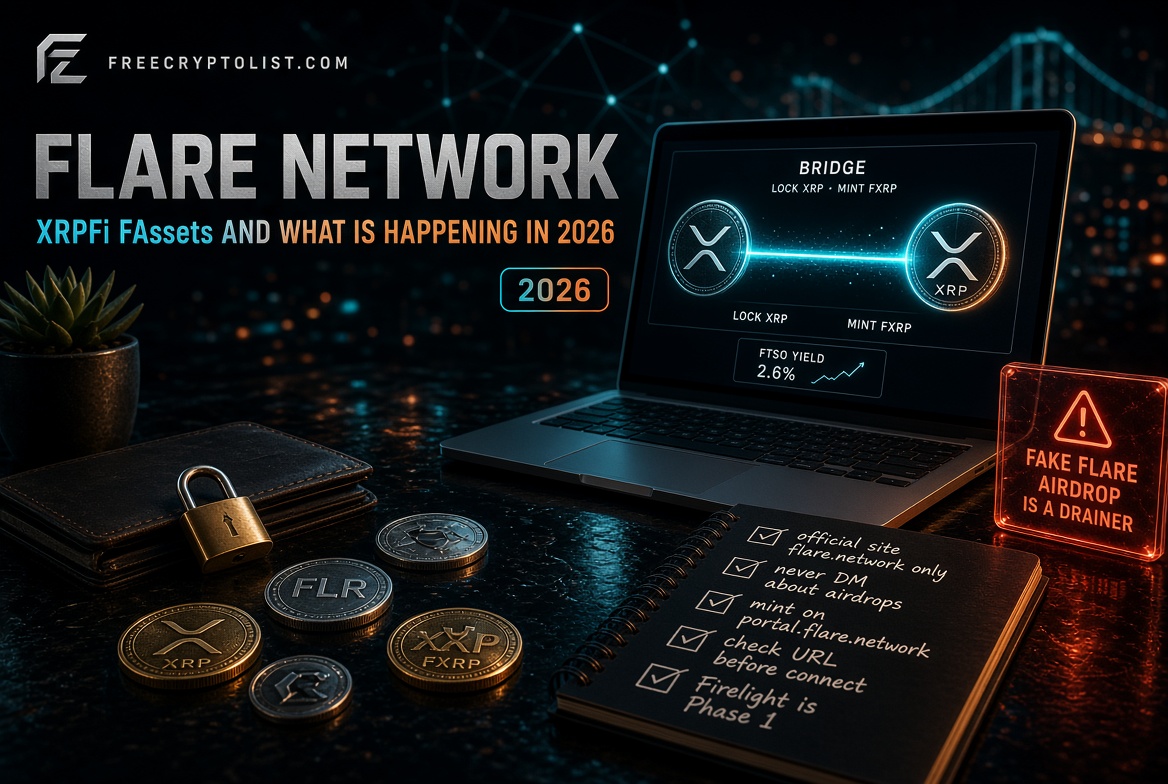
When you mint FXRP, you send real XRP on the XRP Ledger. Flare’s Data Connector checks that the transaction really happened, without relying on a central bridge company. The matching FXRP is then minted on Flare, 1:1 with your XRP. The XRP stays on the XRP Ledger as backing.
When you want your XRP back, you redeem your FXRP. The XRP is released on the XRP Ledger, and the FXRP is burned.
The key difference from many crypto bridges is that the backing is handled by independent “agents” who lock up collateral, including FLR, and the rules are enforced by the protocol, not by a single company holding your XRP. That reduces some risks, but doesn’t remove them. Smart contract bugs, agent problems, and price swings in the collateral are all things to keep in mind.
How to mint: Flare lists four apps for minting FAssets: Oracle Daemon, AU, Luminite, and Oxen Flow. A May 2026 upgrade (FAssets v1.3) also added minting with destination tags, which makes it easier for exchanges and custodians to support FXRP. Always reach these apps from the links on Flare’s official site, not from search ads or DMs.
FXRP after one year (September 2026):
- About 145.2 million FXRP minted, after peaking above 155 million earlier in the year
- About 130 million FXRP, roughly 89.5% of supply, deployed in DeFi rather than sitting idle
- About 21 million FXRP moved to other chains, and FXRP expanded to Ethereum and Base during 2026
What Is XRPFi?
XRPFi is Flare’s name for the DeFi ecosystem built around FXRP and FLR. As of its first anniversary, it includes:
- Kinetic – lending and borrowing
- SparkDEX and BlazeSwap – decentralized exchanges and liquidity pools
- Enosys – liquidity markets, plus borrowing against collateral
- Firelight – XRP staking and on-chain cover (more below)
- Spectra – fixed-rate and yield trading
- earnXRP – vault strategies from Upshift and Clearstar, also available inside the Xaman wallet since February 2026
- A Morpho market with Sentora – since August 2026, FXRP holders can borrow Ripple’s RLUSD stablecoin against FXRP on Ethereum
For XRP holders, XRPFi means something new: earning on XRP without selling it, without handing it to a centralized custodian, and while keeping XRP as the core asset.
FLR – Flare’s Native Token and What It Does
FLR has three main jobs in the ecosystem:
1. Gas fees. Every transaction on Flare costs a small FLR fee, and part of it is burned. After a July 2026 hard fork raised the base fee 20x (from 25 to 500 gwei), a simple transfer costs about 0.064 FLR, still a fraction of a cent.
2. Delegation and staking. Flare runs its own decentralized price feeds (the FTSO) and data system. FLR holders support the network in two ways:
- Delegation: wrap FLR into WFLR and delegate it to a data provider. There’s no minimum and no long lockup, and rewards are paid per reward epoch, which lasts about 3.5 days.
- Staking: lock FLR on Flare’s P-chain with a validator. This needs at least 50,000 FLR and a fixed lockup period.
3. FAssets collateral. FLR is one of the collateral assets that agents lock up to back FXRP, so more FAssets activity means more demand for FLR.
Real yield from delegation: From my own experience delegating about 89,000 WFLR through Bifrost Wallet, I earned about 22 FLR per 3.5-day epoch, which works out to roughly 2.6% APY. That’s a real, on-chain number, and lower than many figures on social media. Keep in mind that reward rates change. FIP.16 (below) cut FLR issuance, staked FLR now counts more than delegated WFLR, and a 20% minimum provider fee applies across the network. Check current rates on Flare Metrics before you decide.
Delegation rewards kept going after the FlareDrops program ended on January 30, 2026. They’re part of how the network itself works, not a promotion.
FIP.16 – Flare’s 2026 Tokenomics Overhaul
On April 24, 2026, Flare governance passed FIP.16 with about 98% of votes in favor. It’s the biggest change to FLR’s economics so far:
Inflation cut from 5% to 3% a year. Since May 14, 2026, new FLR issuance is capped at 3%, with a yearly cap of 3 billion FLR, down from 5 billion. Fewer new tokens means existing holdings get diluted more slowly, but it also means less money for rewards.
Gas fees raised 20x. This took effect with the July 14, 2026 hard fork. More of the network’s activity now turns into burned FLR.
FIRE introduced. FIRE, the Flare Income Reinvestment Entity, collects protocol revenue, such as FAssets minting fees, most data-request fees, and part of redemption fees, and uses it mainly to burn and buy back FLR. Flare’s stated aim is to burn up to around 300 million FLR a year as activity grows. Actual numbers are far lower so far: about 15.6 million FLR burned in 2026 as of early September, and about $31,000 collected by FIRE. We break it down in our FIRE mechanism guide.
Staking over delegation. FLR staked on the P-chain now counts five times as much as delegated WFLR toward a provider’s weight. Staked FLR rose from about 16 billion in July to about 21.5 billion by late August.
The practical meaning: FLR’s value is meant to depend more on real network activity and less on new token issuance. If XRPFi keeps growing, the burn grows with it. If it doesn’t, the burn stays small.
What Is Firelight and stXRP?
Firelight launched in December 2025 as the first XRP staking protocol on Flare. It’s incubated by Sentora, which is also its main technical contributor.
Here’s how it works: you mint or buy FXRP, deposit it into Firelight’s vault, and receive stXRP 1:1. stXRP is a liquid token that represents your staked position. You can hold it, transfer it, or use it in other Flare DeFi apps while your FXRP stays staked.
Demand was strong. The first 25 million FXRP deposit cap filled within about six hours. The cap was raised to 65 million FXRP, and by March 2026 Firelight passed 50 million staked XRP.
Be honest with yourself about where the yield comes from. In Phase 1, depositors received stXRP and Firelight Points, not real staking rewards. Real rewards are planned for Phase 2, when Firelight starts selling on-chain “cover,” a kind of insurance against hacks and exploits, to other DeFi protocols. The fees those protocols pay become rewards for stakers. As of Firelight’s July 2026 update, Phase 2 was being prepared, with launch partners “to be announced soon.”
Phase 2 adds a real risk. If a protocol that bought cover gets hacked and the claim is approved, the payout comes out of the staked pool. A protocol-owned reserve, the First-Loss Buffer, absorbs the first part of a claim. Beyond that, stakers can be slashed, meaning their staked FXRP gets reduced. Phase 2 also brings a longer unstaking window, matching 30-day cover periods. That’s how insurance works. You get paid for taking on risk.
One more thing to know. Firelight screens deposits against sanctions and blacklist databases. In October 2026, it unstaked and returned 117,500 FXRP from 87 addresses that failed screening and barred them from the protocol. After pushback, Firelight said this approach was “unsustainable” and that it would reverse the blacklist and unblock the affected wallets. It’s a reminder that even “decentralized” protocols can have rules that affect your access.
How to Stay Safe in the Flare Ecosystem
Read this before you take part.
Flare and XRP holders are targeted by scammers precisely because XRPFi is real and growing. Scammers create fake campaigns that look exactly like real Flare activity, with stolen logos, convincing URLs, and “claim now” urgency.
We documented one of these in detail: a fake “Flare XRPFi Distribution” campaign that used stolen Flare, Uphold, and Xaman branding to send victims to a wallet drainer. The same pattern shows up again and again in fake Flare campaigns.
Read the full breakdown: Fake Flare XRP Airdrop Scam →
The rules that protect you in the Flare ecosystem:
- The official Flare site is flare.network. Reach minting apps, the Flare Portal, and ecosystem apps from the links there, not from search ads, DMs, or replies on X
- The official Firelight app is at firelight.finance
- Bifrost Wallet’s official site is bifrostwallet.com
- Flare will never DM you about a reward, distribution, or airdrop. Any such message is a scam
- FlareDrops ended on January 30, 2026. Anyone offering a new “FlareDrop” or “FXRP distribution” is running a scam
- Real announcements come from Flare’s official X account (@FlareNetworks) and its website
- Remember that FXRP lives on Flare, which is an EVM chain, so the usual EVM risks apply: check what you sign, and revoke old approvals with Revoke.cash
The Ecosystem at a Glance
If you’re an XRP holder or FLR holder trying to get your bearings, here’s where things stand in October 2026:
Live and working:
- FXRP minting and redemption through Flare’s listed minting apps
- FLR delegation (via Bifrost Wallet or the Flare Portal) and P-chain staking
- Firelight staking (stXRP)
- Lending on Kinetic, liquidity on SparkDEX, BlazeSwap, and Enosys, yield trading on Spectra, and earnXRP vaults
- FXRP on Ethereum and Base, including RLUSD borrowing on Morpho
- FIP.16 tokenomics and the FIRE burn
Coming:
- Firelight Phase 2 (real staking rewards from cover fees, plus slashing risk)
- BTC as an FAsset. Flare says Bitcoin is next on the same system, but hasn’t given a firm date
- Flare Confidential Compute and Protocol Managed Wallets, starting on Songbird, Flare’s live “canary” network where new features are tried first
Tools worth bookmarking:
- Flare Metrics – live FTSO data, provider performance, and reward rates
- Flare Portal – official wrapping, delegation, and staking hub (linked from flare.network)
- DefiLlama’s Flare page – independent TVL tracking
Who Is This For?
Flare and XRPFi make the most sense for:
- XRP holders who want to put their XRP to work rather than letting it sit, and who understand DeFi risk
- FLR holders who want delegation or staking rewards on what they already own
- DeFi users looking for an ecosystem built around real assets rather than purely speculative tokens
If you’re new to DeFi, start small. Try delegating a small amount of FLR, or minting a small amount of FXRP, before you move anything you can’t afford to lose.
Ready to put it into practice? The next article in this series shows how to use Flare as Step 2 of the Compounding Flywheel: how to mint FXRP and put it to work across the XRPFi stack.
→ XRPFi as Flywheel Step 2 – How to Put Your XRP to Work on Flare
This article is for informational purposes only and does not constitute financial advice. Always verify URLs before connecting your wallet. If you’re unsure whether a site is legitimate, check the official Flare Network website at flare.network.
FXRP is a 1:1 version of XRP that works in DeFi on the Flare network. You mint it by sending XRP on the XRP Ledger through Flare’s FAssets system, and you can redeem it back to XRP at any time. FXRP went live on September 24, 2025, and about 145 million had been minted by its first anniversary.
XRPFi is Flare’s name for the DeFi ecosystem built around FXRP and FLR. It includes lending on Kinetic, liquidity on SparkDEX, BlazeSwap, and Enosys, XRP staking on Firelight, yield trading on Spectra, and earnXRP vaults.
Rates change, but they’re modest. In our own experience, delegating about 89,000 WFLR through Bifrost Wallet earned roughly 2.6% APY. FIP.16 cut FLR issuance in 2026 and gave staked FLR more weight than delegated WFLR, so check current rates on Flare Metrics before deciding.
FIP.16, passed in April 2026, cut FLR’s yearly inflation from 5% to 3%, raised gas fees 20x, and created FIRE, a pool that uses protocol revenue to burn and buy back FLR. It also made FLR staked on the P-chain count five times as much as delegated WFLR.
Not yet in the traditional sense. Phase 1 gave depositors stXRP and Firelight Points. Real rewards are planned for Phase 2, paid from fees that DeFi protocols pay for on-chain cover. Phase 2 also adds slashing risk: if a covered protocol is hacked, stakers can lose part of their FXRP.
No. The FlareDrops program ended on January 30, 2026. Any message, site, or post offering a new FlareDrop, XRPFi distribution, or FXRP airdrop is a scam designed to drain your wallet. Flare will never DM you about rewards.
Sources
- Flare Network – FAssets
- Analytics Insight – FXRP marks one year on Flare as XRPFi infrastructure expands (Sep 2026)
- KuCoin News – 145M FXRP minted on Flare (Sep 2026)
- DefiLlama Research – Flare’s tokenomics revamp (Sep 2026)
- Flare Network – From activity to value accrual: our plan for FLR
- The Block – Firelight launches XRP staking protocol on Flare (Dec 2025)
- CryptoPotato via MEXC – Firelight passes 50M staked XRP (Mar 2026)
- Firelight – Everything stakers need to know about Phase 2 (Jul 2026)
- KuCoin News – Firelight to roll back blacklist process (Oct 2026)
- Kiln Docs – Flare (FLR) delegation and staking
- The Block – XRP Ledger’s EVM sidechain launches on mainnet (Jun 2025)
📖 In This Series XRPFi Flywheel Step 2 · Flare FIRE Mechanism · Fake Flare XRP Airdrop Scam · The Compounding Flywheel