Onyx Is Moving to Layer 1 – What XCN Holders Need to Know Before December 31
Updated October 10, 2026
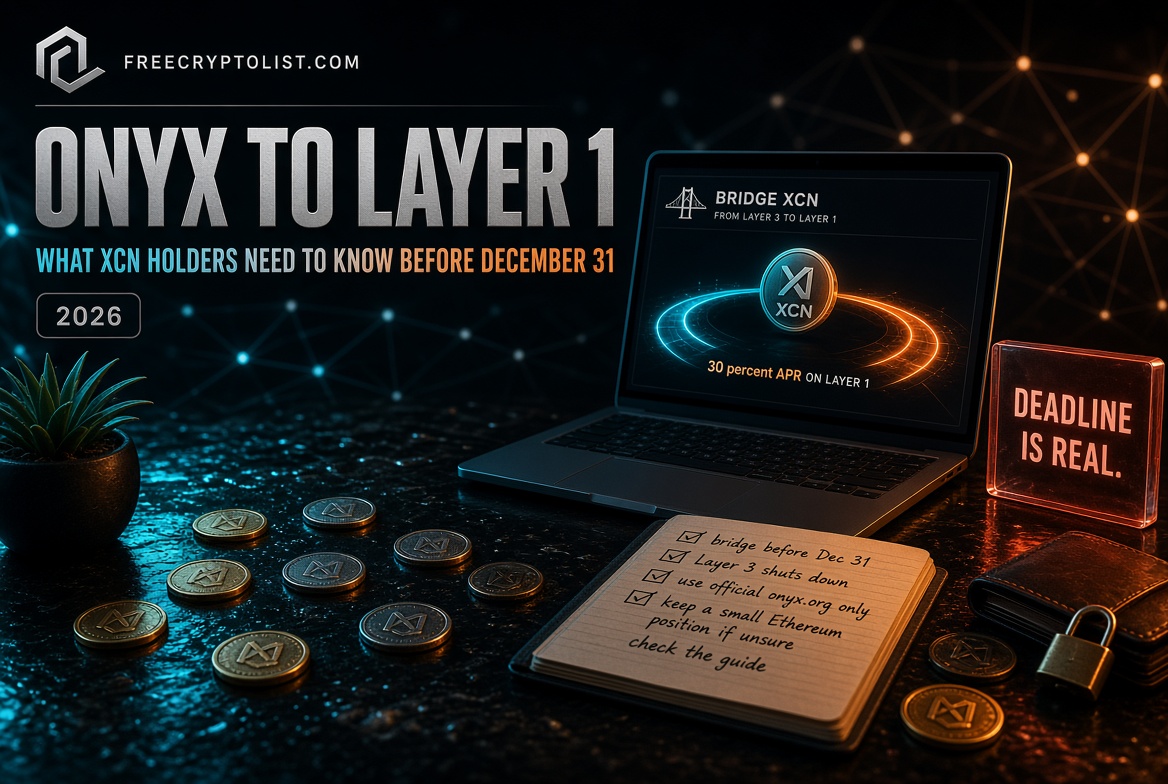
If you hold XCN, there’s a real deadline coming: Onyx will shut down its Layer 3 network, the XCN Ledger, on December 31, 2026.
The short version: Onyx has moved its whole ecosystem to its own Layer 1 blockchain, Onyx Goliath, which launched in late March 2026. Governance moved there in July, Layer 1 staking pays a much higher rate than Ethereum (Onyx currently shows about 30% for liquid staking), and the Layer 3 is being retired. If any of your XCN sits on the Layer 3, move it before December 31. XCN on Ethereum isn’t going away, but Onyx is pushing everyone toward Layer 1. And before you move anything, read the section below on the October 2026 treasury transfer, which hasn’t been fully explained yet.
A Brief History of Onyx
To understand where Onyx is going, it helps to know where it came from.
Onyx began life under the Chain brand, and its token was renamed Onyxcoin (XCN) in 2023. Onyx became known for a DeFi lending protocol on Ethereum, where users could lend and borrow crypto. XCN was its governance and utility token, an ERC-20 on Ethereum.
Onyx later launched the XCN Ledger, a Layer 3 network built on Arbitrum Orbit that settled to Base. The idea was a faster, cheaper home for XCN apps, and users could bridge XCN to the Layer 3 to use them.
Meanwhile, Onyx was building something bigger: Onyx Goliath, its own proof-of-stake Layer 1 blockchain, aimed at banks and financial institutions. XCN pays for transaction fees, staking, and network security there. Goliath’s mainnet launched in late March 2026, and a public block explorer followed in July.
With Layer 1 live, Onyx decided the Layer 3 was no longer needed. On July 2, 2026, it announced the Layer 3 would be deprecated and shut down on December 31, 2026.
What Happened in 2026
April 27 – Upbit listing. South Korea’s largest exchange, Upbit, added XCN to its KRW and USDT markets. The listing pushed XCN to a three-month high, though the excitement faded afterward.
July 1 – Onyx Mesh launched. Onyx Mesh is infrastructure for regulated financial institutions to handle things like settlement and custody on Onyx Layer 1, built with Chain. It’s the piece meant to turn Onyx’s “blockchain for banks” pitch into something real. As of mid-August, though, no institutional customers or live settlement volume had been publicly disclosed.
July 2 – Layer 3 shutdown announced for December 31, 2026.
July – Two big governance votes passed.
- OIP-68, “Onyx Points Season 3, Layer 1 Incentive Expansion and Governance Activation,” passed with nearly all votes in favor. It raised Layer 1 staking rewards to about 30% APR, launched Points Season 3 (earned mainly through Layer 1 activity such as staking, liquid staking with stXCN, and farming), and wrapped up Season 2 with 25 million XCN set aside for distribution
- OIP-69, “Activate Onyx Layer 1 Governance,” passed unanimously. Proposals and votes now happen on Onyx Layer 1 instead of Ethereum
That second change matters more than it sounds. Governance is where the real power lives: who sets the staking rate, controls the treasury, and steers the roadmap. Moving governance to Layer 1 makes it the permanent center of the ecosystem.
September – Chain acquisition approved. On September 1, Onyx announced an agreement to acquire Chain’s fintech infrastructure, part of a push toward neobank-style services. Holders approved it in a Layer 1 governance vote (OIP-4), and it moved into execution in early September. XCN rallied about 20% after the vote.
October 2026: The 620 Million XCN Treasury Transfer
On October 6-7, 2026, about 620 million XCN moved out of the Onyx DAO’s Ethereum treasury contract, leaving about 1.89 million XCN behind. Reports describe it as carrying out a migration proposal Onyx had announced earlier. At the same time, security firm Blockaid issued an alert about a possible vulnerability exploit, and some community posts claimed the treasury had been drained through a governance exploit.
As of October 10, we couldn’t find an official Onyx statement that settles which explanation is right, or whether the Blockaid alert and the transfer are connected. Until it’s clear:
- Follow only Onyx’s official channels, onyx.org and the official X account (@Onyx), for updates
- Be extra careful of “urgent migration” or “claim your compensation” messages. Scammers jump on moments like this
- Don’t approve anything on a site you reached through a DM or a reply. Our guide to wallet drainer approvals explains what to look for
We’ll update this article when Onyx explains what happened.
The Economics – Why Layer 1 Pays So Much More
The big gap between Layer 1 staking and Ethereum staking isn’t an accident. It’s a deliberate incentive to move.
Onyx needs capital, validators, and users on Layer 1 to make it attractive to the institutions Onyx Mesh targets. A blockchain with no activity can’t attract banks. So Onyx is spending token emissions now, paying high staking rewards, to pull as much XCN as possible onto Layer 1.
Is about 30% sustainable? Probably not long-term. The rate is mostly paid with newly issued or treasury XCN, not with fees from real network use. Onyx’s own documentation says reward rates are variable, that the protocol owner can change rates and fees or pause staking, and that the APY isn’t guaranteed. As more XCN is staked, or if governance votes for changes, the rate is likely to drop unless real fee revenue grows to support it.
Token unlocks add pressure. According to CoinGecko’s tracker, about 296 million XCN unlocked on August 15, 2026, and another similar unlock of about 296 million XCN is scheduled for October 15, 2026, split between the DAO Treasury and the Foundation. Unlocked tokens aren’t automatically sold, but they add to the supply that could be.
What to watch:
- Staked XCN and TVL on Layer 1 – is capital actually moving?
- Transaction volume – real fees are what could make rewards sustainable
- Governance proposals – any change to the staking rate comes through Layer 1 governance
- Onyx Mesh customers – named institutions using it would be the strongest signal
- Points announcements – Season 3 is active, but how Points convert hasn’t been announced
What About the Points Program?
Onyx Points have built up across Seasons 1, 2, and now 3. Nobody outside the Onyx team knows exactly what they’ll become.
What we know: Points are earned through staking, liquid staking, farming, governance, and other ecosystem activity. Season 2 ended with 25 million XCN set aside for distribution.
What we don’t know: the exact conversion formula, snapshot dates, or whether future rewards will be XCN, stXCN, governance weight, or something else.
Points appear to be tracked by wallet address rather than by chain, so moving your XCN to Layer 1 shouldn’t wipe out points you earned before. But nobody can guarantee the final rules. Don’t make big decisions based on what Points might be worth.
The Layer 3 Deadline – December 31, 2026
This is the part that needs action before the end of the year.
The Onyx Layer 3, the XCN Ledger on Arbitrum Orbit, shuts down on December 31, 2026. If you have XCN on the Layer 3, bridge it to Ethereum or to Layer 1 before then. Onyx hasn’t said what happens to XCN left on the Layer 3 after the shutdown, so don’t wait to find out.
XCN on Ethereum isn’t being retired. In its July announcement, Onyx said the Ethereum ERC-20 contract “remains the primary representation of XCN.” Onyx’s website now also calls XCN “the native token of the Onyx Layer 1,” and that’s clearly where the ecosystem is heading.
Not sure where your XCN is? Check which network your wallet shows it on. Ethereum appears as the standard Ethereum network, while the Layer 3 appears as the XCN Ledger. Many people who used the Onyx XCN Wallet app were on the Layer 3, since that wallet ran there.
What Should XCN Holders Do?
Here’s a simple decision guide:
If your XCN is on the Layer 3: Move it before December 31. Bridge it to Ethereum or Layer 1 using the official bridge at app.onyx.org.
If your XCN is staked on Ethereum: Layer 1 staking currently pays much more. In our own migration, the whole process cost under $0.20 in gas. Our step-by-step guide with real screenshots walks through it: How to Bridge XCN from Ethereum to Onyx Layer 1. Given the open questions about the October treasury transfer, it’s reasonable to wait for Onyx’s explanation before moving a large amount.
If your XCN sits unstaked on Ethereum: Same idea. Consider bridging and staking on Layer 1, and maybe keep a small amount on Ethereum for flexibility.
If you’re not sure: Do nothing with your Ethereum XCN while you research. Just don’t ignore the December 31 deadline if anything is on the Layer 3.
New to bridging? Our guide to bridging crypto between networks covers the basics, and what is liquid staking explains how stXCN-style tokens work.
The Honest Risk Assessment
Onyx has delivered a lot in 2026: the Layer 1 mainnet, Onyx Mesh, governance on Layer 1, and an approved acquisition. The team ships. But the risks are real:
Treasury and security risk. The October 620M XCN transfer and Blockaid alert are unresolved as of this update. Onyx’s lending protocol was also exploited in September 2024 for about $3.8 million. Past exploits don’t mean future ones, but they belong in your risk assessment.
Adoption risk. Institutional adoption is the core thesis. If banks don’t actually use Onyx Mesh, the activity needed to support staking rewards won’t show up.
APR risk. About 30% is driven by incentives, and Onyx says it isn’t guaranteed. Expect it to change.
Supply risk. Regular token unlocks add supply that could be sold.
Points uncertainty. Nobody knows what Points will become.
Smart contract risk. Bridging and staking rely on smart contracts, and Onyx’s docs note that contracts can be upgraded and staking paused by the protocol owner. No smart contract is risk-free.
Price risk. XCN has a history of big price swings, and in 2026 it traded around a third of a cent. A high staking APR can still lose money in dollar terms if the price falls.
Size your position accordingly. This is a bet on Onyx executing an interesting plan, not a guaranteed outcome. Our due diligence guide is a good checklist for any project like this, and remember that staking rewards are generally taxable income in the US. See our guide to crypto tax on free earnings.
For the step-by-step migration walkthrough with real screenshots: How to Bridge XCN from Ethereum to Onyx Layer 1
For informational purposes only. Not financial advice. Always use official URLs only: onyx.org and app.onyx.org.
Onyx announced on July 2, 2026 that its Layer 3, the XCN Ledger built on Arbitrum Orbit, will be deprecated and shut down on December 31, 2026. If you have XCN on the Layer 3, bridge it to Ethereum or Onyx Layer 1 before then using the official bridge at app.onyx.org.
Yes, the shutdown only affects the Layer 3. Onyx said in July 2026 that the Ethereum ERC-20 contract remains the primary representation of XCN. Onyx is encouraging holders to move to its Layer 1, but you don’t have to move XCN off Ethereum.
Onyx currently shows about 30% APR for liquid staking on Layer 1, after the OIP-68 governance vote in July 2026. The rate is variable and mostly incentive-driven, and Onyx’s documentation says it isn’t guaranteed and can be changed by the protocol owner.
On October 6-7, 2026, about 620 million XCN moved out of the Onyx DAO’s Ethereum treasury. Reports described it as a previously announced migration proposal, while security firm Blockaid flagged a possible exploit at the same time. As of October 10, 2026, no official Onyx statement had settled which is correct. Follow only Onyx’s official channels for updates.
Points appear to be tracked by wallet address rather than by chain, so moving XCN to Layer 1 shouldn’t erase points earned earlier. Onyx hasn’t published the final conversion formula or snapshot rules, so nobody can guarantee how Points will be treated. Don’t base big decisions on Points alone.
Use the official Onyx bridge at app.onyx.org. In our own migration, the whole process cost under $0.20 in gas. Our step-by-step guide, How to Bridge XCN from Ethereum to Onyx Layer 1, walks through every screen with real screenshots.
Sources
- Onyx Blog – Deprecating the Onyx Layer 3 to focus on Layer 1 (Jul 2026)
- Onyx – XCN Token
- Onyx Docs – Staking and stXCN
- CoinMarketCap – Onyxcoin latest updates
- Tapbit – Why is Onyxcoin back in focus? (Aug 2026)
- Tapbit – Neobank governance, OIP-4 and the next token unlock (Sep 2026)
- AMBCrypto – Onyxcoin rallies 20% after neobank vote (Sep 2026)
- ChainCatcher – Onyx transfers 620 million XCN (Oct 2026)
- KuCoin News – Onyx treasury transfers 620M XCN amid security alert (Oct 2026)
- QuillAudits – Onyx DAO exploit analysis (Sep 2024)
📖 Related Guides How to Bridge XCN to Onyx Layer 1 · How to Bridge Crypto · What Is Liquid Staking · How to Stake Crypto