Trezor Wallet Review 2026: Safe 3 vs Safe 5 vs Safe 7 Compared
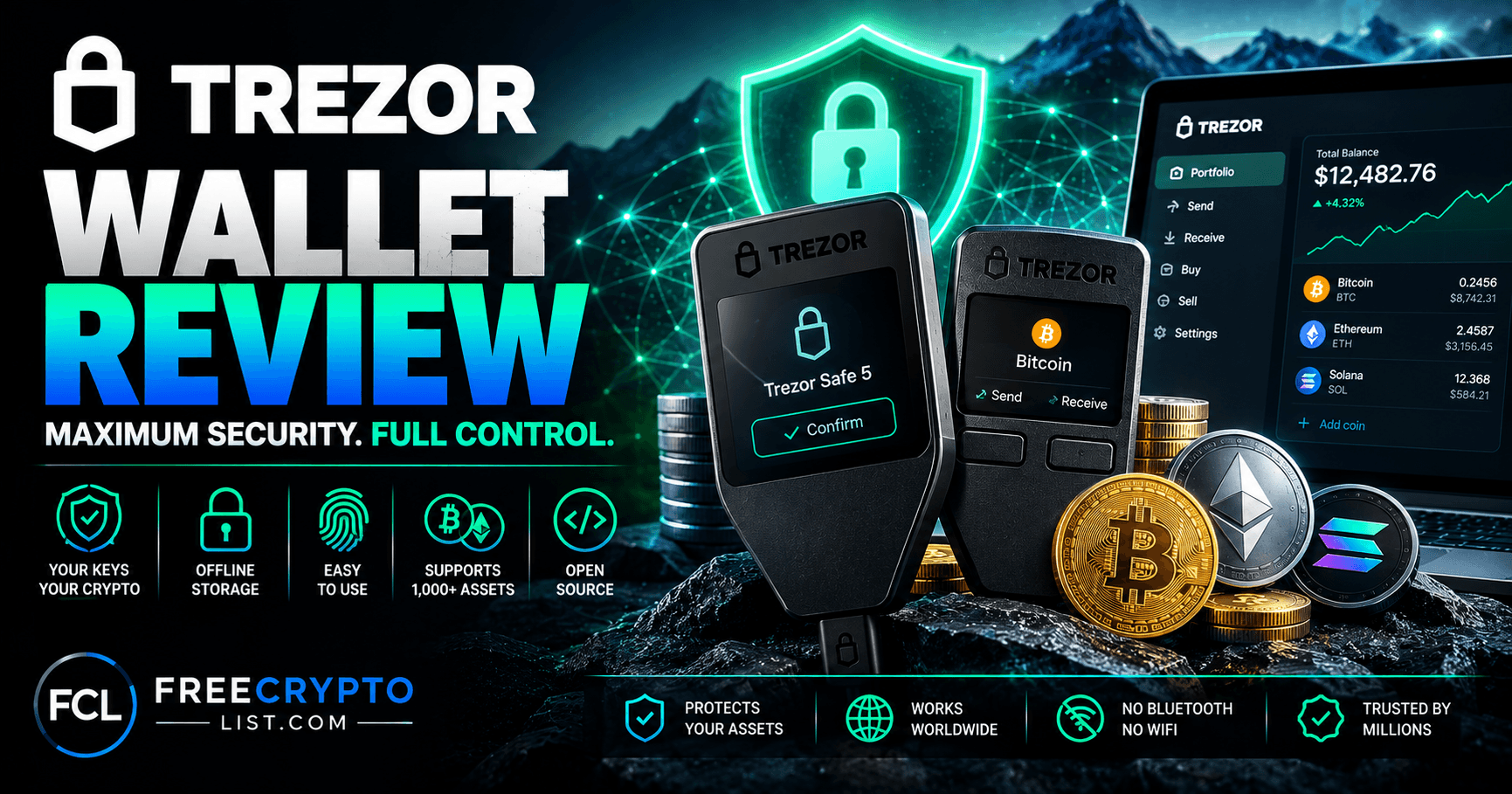
Trezor didn’t just enter the hardware wallet market – it created it. The Trezor Model One, launched in 2014 by Prague-based SatoshiLabs, was the world’s first cryptocurrency hardware wallet. Over a decade later, the company (now selling the Safe 3, Safe 5, and Safe 7) is still one of the two names everyone compares everything else against, alongside Ledger. This review covers what’s actually different across the three current models, Trezor’s real security track record, and where its full open-source approach genuinely matters versus where it’s just a talking point.
At a glance: Non-custodial hardware wallet line from SatoshiLabs, a Czech company founded in Prague around 2013. Fully open-source hardware and firmware since the very first device – a real differentiator from closed-source competitors. Current lineup spans $79 to $249 depending on features. Two disclosed data breaches since 2024, both third-party vendor incidents (support ticketing, shipping fulfillment) rather than wallet or firmware compromises. Rated 4.6/5 on Trustpilot across 2,011 reviews.
The Three Current Models
Trezor retired the original Model One and Model T (legacy support only, no longer sold) in favor of the Safe line, all three of which use a certified secure element – something the original models lacked and were criticized for versus Ledger.
| Model | Price | Display | Security | Best For |
|---|---|---|---|---|
| Safe 3 | $79 | 0.96″ monochrome, 2-button pad | EAL6+ certified secure element | Budget-conscious buyers who just want solid cold storage |
| Safe 5 | $169 | 1.54″ color touchscreen | EAL6+ dual secure element architecture | Most people – touchscreen convenience without the flagship price |
| Safe 7 | $249 | 2.5″ color touchscreen | Dual secure element (TROPIC01, EAL6+), “quantum-ready” cryptography | Buyers who want the latest hardware – wireless Bluetooth, Qi2 wireless charging, aluminum body, full iOS support |
The jump from Safe 3 to Safe 5 is mostly about the touchscreen (verifying addresses on-device is easier and safer with a real screen versus a 2-button pad). The jump to Safe 7 is a genuine flagship upgrade – it’s the first hardware wallet built with post-quantum cryptography readiness and uses TROPIC01, an open-source secure chip built by Tropic Square, a SatoshiLabs spinoff. If you’re just getting started, our how to set up a crypto wallet guide covers the basics of wallet types before you pick specific hardware.
Why Open Source Actually Matters Here
Trezor’s firmware and hardware schematics have been open source since the Model One in 2014. That means independent security researchers worldwide can (and regularly do) audit the code rather than trusting the company’s word for it. This is a real, substantive difference from wallets that rely on closed-source secure elements you simply have to trust – it’s one of the stronger legitimate arguments in Trezor’s favor, not just marketing language.
Security Track Record
Trezor’s disclosed incidents look structurally different from most competitors: both were third-party vendor breaches, not failures of the wallet hardware or firmware itself.
- January 2024 – A third-party support ticketing system used by SatoshiLabs was breached, exposing names and email addresses of roughly 66,000 customers who had contacted support since December 2021. Attackers used the stolen contact list to directly phish at least 41 customers by email, requesting seed phrase information. SatoshiLabs was clear that no legitimate Trezor representative will ever ask for a seed phrase.
- August 2026 – Trezor’s shipping fulfillment partner, ShipMonk, suffered a breach exposing names, emails, phone numbers, and shipping addresses for roughly 14,000 customers across seven countries. Trezor confirmed its own systems and wallet security were not compromised, and no confirmed cases of the data being sold or used in scams had surfaced as of the disclosure.
In both cases, the wallets themselves and the private keys stored on them were never at risk – the exposure was contact and shipping data, which raises phishing and targeted-scam risk rather than direct theft risk. That’s a meaningfully different (and better) pattern than a firmware or secure-element vulnerability would be.
What Real Users Say
Trezor holds a 4.6/5 (“Excellent”) rating on Trustpilot across 2,011 reviews, with 77% five-star. Praise consistently centers on responsive, knowledgeable customer support – reviewers specifically call out support staff following up and resolving issues rather than leaving tickets open.
The negative side is smaller (13% one-star) but worth showing honestly: one detailed complaint came from a user who lost $20,000 in crypto and blamed Trezor after support told him “sorry, but it happens, and there is nothing we can do.” Trezor’s response – that hardware wallets cannot reverse blockchain transactions and a compromised backup or seed phrase is a user-side issue, not a device failure – is accurate. It’s a useful real-world reminder that the wallet only protects your keys; it can’t protect you from phishing or backup mistakes.
Watch Out For
- Two vendor data breaches since 2024, both increasing phishing/scam exposure rather than fund-theft risk directly – but they mean anyone who’s ever contacted Trezor support or ordered a device should stay alert for impersonation emails referencing real order details.
- No legitimate Trezor employee will ever ask for your seed phrase or recovery data – full stop, regardless of how official an email or call looks, especially given the Jan 2024 breach specifically fueled targeted phishing.
- iOS support varies by model – Safe 3 and Safe 5 have limited iOS functionality; only Safe 7 offers full iOS compatibility.
- A hardware wallet cannot undo a mistake. If you approve a malicious transaction, get phished for your seed phrase, or lose your backup, Trezor (like any hardware wallet) cannot reverse it or recover it for you.
Dan’s Verdict
Trezor earns its reputation honestly. The open-source track record going back over a decade is a real, verifiable advantage, and the fact that both of its security incidents were vendor-side data exposures rather than wallet compromises says something genuinely good about how the core product is built. For most people, the Safe 5 is the sweet spot – touchscreen verification without paying flagship price. If you want the newest hardware and don’t mind spending more, the Safe 7‘s quantum-ready design and wireless convenience are legitimately forward-looking, not just gimmicks. Budget buyers shouldn’t feel shortchanged by the Safe 3 either – it has the same certified secure element, just a simpler interface. Wherever you land, treat the two data breaches as a phishing-awareness reminder: your device is solid, but your inbox is still a target.
You can grab a Trezor wallet here.
For more on evaluating hardware wallets generally, see our Tangem Wallet Review if you want to compare the seedless NFC approach against Trezor’s traditional seed-phrase model, and our review methodology for how we evaluate platforms and products.
Yes. Trezor, made by SatoshiLabs in Prague, launched the world’s first hardware wallet in 2014 and has kept its hardware and firmware fully open source ever since, allowing independent security researchers to audit the code.
The Safe 5 ($169) is the best fit for most people, offering touchscreen verification at a mid-range price. The Safe 3 ($79) covers the essentials for budget buyers, and the Safe 7 ($249) is the flagship with wireless connectivity and quantum-ready cryptography.
Trezor’s wallet hardware and firmware have not been compromised. The company has disclosed two data breaches – a January 2024 support-system breach exposing 66,000 users’ names and emails, and an August 2026 shipping-partner breach exposing 14,000 customers’ contact and address data. Both increased phishing risk but did not compromise any wallet’s private keys.
Yes, Trezor’s hardware design and firmware have been open source since the original Model One in 2014, making it one of the few hardware wallets that lets independent researchers fully audit its security rather than relying on a closed, proprietary design.
The Safe 7 is the flagship: a larger touchscreen, dual secure elements including the open-source TROPIC01 chip, wireless Bluetooth and Qi2 charging, an aluminum body, quantum-ready cryptography, and full iOS support. The Safe 5 has a smaller touchscreen, USB-C only connectivity, and limited iOS functionality, at a lower price.
Trezor’s current lineup starts at $79 for the Safe 3, $169 for the Safe 5, and $249 for the flagship Safe 7.