Tangem Wallets Review 2026: Seedless Hardware Wallet, Tested
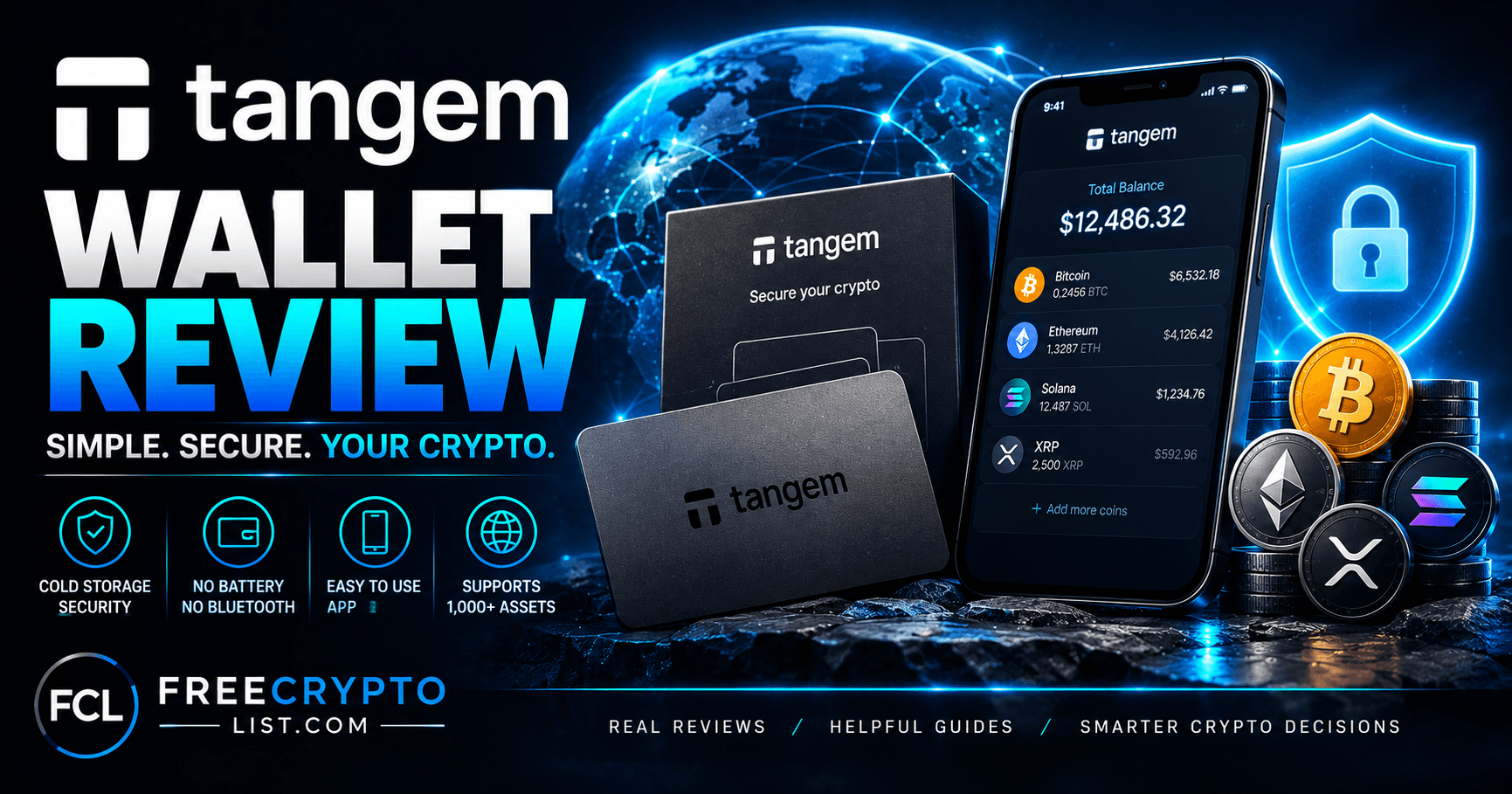
Tangem is a hardware wallet that skips the part everyone hates about hardware wallets: the seed phrase. Instead of writing down 12 or 24 words, your private key is generated and lives entirely inside an NFC card or ring, and you unlock it by tapping your phone. It sounds almost too simple for cold storage, so this review digs into whether that simplicity actually holds up security-wise, what Tangem’s real track record looks like, and which of its five product configurations is actually worth buying.
At a glance: Non-custodial, seedless-by-default NFC hardware wallet from a Swiss company (Tangem AG, founded 2017), using a Samsung EAL6+ certified secure element – the same certification tier used in passports and banking chips. No battery, no ports, no firmware to update, which also means less attack surface. Pricing runs $59.90 to $180 depending on configuration. Three disclosed security issues since 2024, all patched or addressed, none resulting in confirmed user fund loss. Real user complaints cluster around customer support responsiveness, not the hardware itself.
How Tangem Actually Works
Each Tangem card or ring contains a Samsung S3D350A chip, EAL6+ certified (the same secure element tier used in Ledger’s chips, for comparison, on our Ledger review). When you activate a Tangem wallet, the chip generates your private key on-device and it never leaves the chip – not during setup, not during a transaction, not ever, unless you explicitly opt into an app-generated seed phrase as a secondary backup. Signing happens on-chip: your phone (any NFC-enabled iOS or Android device) is just the interface that relays the transaction to sign and taps the card to authorize it. If you’re setting up a wallet for the first time and want the fuller walkthrough on wallet types generally, our how to set up a crypto wallet guide covers the basics before you get into hardware-specific setup.
Because there’s no seed phrase by default, the backup model works differently than a Ledger or Trezor – Tangem sells cards in sets (2 or 3), and every card in a set holds an independent, linked copy of the same key. Lose one card, and the remaining card(s) still get you into your wallet. This is also exactly where the model’s one real weakness lives – see Watch Out For below.
Security Track Record
The EAL6+ chip and Kudelski Security / Riscure independent audits are genuinely strong credentials. But “seedless” and “audited” don’t mean “no incidents,” and Tangem has three disclosed security issues worth knowing about plainly rather than glossing over:
- December 2024 – A Reddit user publicly flagged that seed phrases entered during setup (for users who opted into the app-based seed phrase backup) were being logged into email and internal support-ticket histories, meaning they were technically visible to Tangem staff rather than staying fully isolated. Tangem acknowledged the issue and shipped a patch within a day of the public disclosure.
- September 2025 – A public dispute with Ledger’s Donjon security research team over a reported vulnerability and how Tangem characterized its severity and fix.
- July 2026 – A disclosed physical laser fault-injection attack against the secure element, the kind of lab-grade attack that requires physically possessing the device and specialized equipment – not a remote or software exploit.
None of these are “funds were stolen” events – they’re disclosed vulnerabilities that got patched or addressed, and the physical laser attack in particular requires resources far beyond casual theft. But three disclosures in under two years is a real pattern to be aware of, not nothing.
Product Lineup and Pricing
| Product | Price | What’s Included | Best For |
|---|---|---|---|
| 2-Card Set | $59.90 | 2 linked cards | Budget cold storage – just be aware you only have one backup card |
| 3-Card Set | $69.90 | 3 linked cards | The set we’d actually recommend – the third card lets you split backups across separate physical locations |
| Tangem Ring | $160 | Ring + 2 cards | Wearable, tap-to-sign convenience for frequent transactions and DeFi use – same EAL6+ chip as the card |
| Family Pack | $129.80 | Two independent 2-card sets | Two people who each want their own separate cold wallet |
| Pro Kit | $180 | Ring + card set bundle | Combining wearable convenience with vault-style cold storage in one purchase |
The Card and Ring share identical security internals. The real difference is how you use them day to day: the card set is built for cold storage you rarely touch, while the Ring stays on your hand for spontaneous DeFi and daily transactions without digging a card out of a drawer. One caveat on the Ring specifically – it’s sized like jewelry, so getting the sizing right at purchase matters since you can’t easily “downsize” a ceramic ring later.
What Real Users Say
Tangem sits at 4.0/5 (“Great”) on Trustpilot across 1,023 reviews, with 69% five-star. The praise and the complaints both follow a consistent pattern:
What people like: ease of setup even with zero crypto background (“a man of 72 who knows very little about crypto… found the setup straightforward”), reliable hardware that works out of the box, low-fee in-app token swaps, and steady feature improvements through app updates.
What people complain about: almost never the hardware itself – it’s customer support. Recurring themes include warranty replacement requiring multiple videos of proof before Tangem would swap a failed card, slow or unhelpful follow-up on support tickets, and confusion during setup around terminology (some users expect “set up wallet” to mean “set up a seed phrase,” which isn’t how the seedless flow works by default).
Company Background
Tangem AG was founded in 2017 in Zug, Switzerland – the same “Crypto Valley” region where several other blockchain infrastructure companies are based. The company shipped its first product, a single-asset NFC card called Tangem Note, in 2018, followed by the first NFC hardware wallet (Wallet v1) in 2022 and a multi-asset v2 in 2023. That same year, Tangem raised an $8 million funding round led by Shima Capital with SBI Digital Asset Holdings participating, under CEO Andrey Kurennykh. The Ring launched in 2024, and a non-custodial Visa card product (Tangem Pay) followed in 2025. As of 2025, Tangem reports having shipped over 6 million cards across 230 countries, with a team of roughly 250 people across 43 countries.
Watch Out For
- Support response times. The single most consistent complaint across reviews is slow or bureaucratic customer support, particularly around warranty claims – not hardware failure itself.
- The seedless model’s hard limit. If you lose every card in your set and never opted into the app-generated seed phrase backup, your funds are permanently unrecoverable. There’s no customer support recovery path, no “prove you own it” fallback. If you buy Tangem, buy the 3-card set and actually store the extra card somewhere separate.
- Three disclosed security incidents since Dec 2024. All patched or addressed, none confirmed to have resulted in stolen funds, but worth going in with eyes open rather than assuming “EAL6+ certified” means a spotless record.
- Ring sizing is a one-time decision. Order the wrong size and you’re dealing with a return, not an adjustment.
- Non-custodial and unregulated, like every hardware wallet in this category – you are entirely responsible for your own backup discipline. That’s the trade-off of self-custody generally, not a Tangem-specific flaw, but worth stating plainly since a good chunk of Tangem’s appeal is “so simple I don’t have to think about it.”
Dan’s Verdict
Tangem is legitimate, well-engineered, and does genuinely solve the biggest reason people put off buying a hardware wallet in the first place – the seed phrase. The chip, the audits, and the seedless architecture are the real deal. My honest take: skip the 2-card set. Get the 3-card set specifically so you can split backups across two locations, and seriously consider opting into the app-generated seed phrase during setup as a true disaster-recovery net, even though it’s optional. Go in knowing support can be slow if something goes wrong with a physical card, and knowing this is a company with three disclosed security issues in under two years – none catastrophic, but a pattern worth watching rather than ignoring. For most people who want cold storage without the anxiety of a 24-word list, it’s a solid pick. For anyone who wants a wallet with a longer, quieter track record, Ledger remains the more conservative choice.
You can grab a Tangem wallet here, this link gets you 10% discount on the wallet.
For more on evaluating hardware and platforms generally, see our review methodology and the Crypto Security hub.
Yes. Tangem AG is a Swiss company founded in 2017 that has shipped over 6 million cards. It uses a Samsung EAL6+ certified secure element, the same certification tier used in passports and banking chips, and has been independently audited by Kudelski Security and Riscure.
No, not by default. Tangem generates and stores your private key entirely on the chip, and it never leaves the card unless you specifically opt into an app-generated seed phrase as an additional backup during setup.
If you have another linked card from the same set, you still have full access to your funds. If you lose every card in your set and never created a backup seed phrase, your funds are permanently unrecoverable. This is why buying the 3-card set and storing cards in separate locations matters.
Tangem has disclosed three security issues since December 2024: a logging flaw that exposed some seed phrases to internal systems (patched within a day), a dispute with Ledger’s Donjon research team over a reported vulnerability, and a physical laser fault-injection attack that requires possessing the device and specialized lab equipment. None have resulted in confirmed user fund loss.
Both use identical security hardware. The Card is meant for cold storage you rarely touch and comes in sets of 2 or 3 for backup redundancy. The Ring is a wearable version meant for frequent, tap-to-sign transactions and DeFi use, sold as a set with 2 backup cards.
Pricing ranges from $59.90 for a 2-card set up to $180 for the Pro Kit bundle. The 3-card set at $69.90 is generally the best value since it adds real backup redundancy for only $10 more than the 2-card set.