How to Tell if a Crypto Project Is Actually Worth Your Time (A Practical Due Diligence Guide)
Updated October 4, 2026
Here’s something nobody tells you when you’re getting started in crypto: the biggest risk isn’t missing the next big thing. It’s putting money into something that looked great on X and turned out to be nothing.
The space is full of projects with loud communities, flashy websites, and influencers calling them “the next Solana.” Most of them don’t survive a bear market. Some are outright scams. A few are genuinely valuable.
The difference between the real ones and the noise almost always shows up in the data – if you know where to look and what questions to ask. The short version: rule out a scam first, then check whether real people pay to use the product, whether the token supply is about to flood the market, whether users stay when rewards stop, and whether anyone is actually building. Score it honestly before you put in a cent.
This guide shows you exactly how to do that. No finance degree required.
First – Why Social Media Is the Wrong Starting Point
When everyone on X is talking about a token, that’s usually a sign you’re already late. Social media is built for engagement, not accuracy. Hype spreads fast. Corrections spread slowly. And in 2026, a lot of that hype isn’t even human – AI-generated accounts and fake influencers can manufacture “community excitement” at scale (see our fake crypto influencers guide).
The people who consistently do well in crypto aren’t the ones who find the loudest projects – they’re the ones who find the real ones before they get loud. They do that by looking at the data, not the discourse.
A simple test before you start any research: would you still be interested in this project if X stopped talking about it tomorrow? If the answer is no, that’s a red flag right there.
Step Zero – Rule Out an Outright Scam
Before you evaluate whether a project is a good investment, make sure it isn’t a trap. This takes five minutes:
- Get the token’s contract address from the project’s official website – never from a link someone sent you – and confirm the one you’re looking at matches
- Run the contract through Token Sniffer or GoPlus Security (EVM chains) or RugCheck (Solana) to catch honeypots, hidden taxes, and mint functions
- Check the holder list on DexScreener and whether the top wallets are linked using Bubblemaps
If it fails any of these, stop – there’s no point analyzing the tokenomics of a rug pull. Our rug pull guide walks through these checks in detail, and our honeypot tokens guide explains the most common trap.
1. TVL – Useful, But Easy to Game
TVL stands for Total Value Locked. It measures the total dollar value of assets deposited into a protocol’s smart contracts. You’ll see it everywhere when researching DeFi, and DeFiLlama is the standard free place to look it up.
High TVL can be a good sign – it means real people are willing to put real money into the system. But the useful question isn’t just “what is the TVL?” – it’s “what does this TVL actually tell me, and what can it hide?”
TVL is one of the most easily manipulated metrics in crypto. A project can inflate it by offering massive yield farming rewards. Money floods in chasing the yield, TVL looks impressive, and the moment rewards dry up, the money leaves just as fast. In 2025, Algorand Foundation researchers studied more than 300 cryptocurrencies and found that TVL on its own was not a meaningful predictor of token returns – and warned that it can be too easily gamed.
So instead of just asking how much TVL a project has, ask what’s actually locked in there. Is it real user deposits – stablecoins, ETH, BTC from genuine participants? Or is it mostly the project’s own token, propped up by temporary incentives? (If you’re new to how deposits and pools work, our DeFi explainer and liquidity pools guide cover the basics.)
TVL size matters. TVL quality matters more.
2. Revenue – The Metric That’s Much Harder to Fake
If TVL shows attention, revenue shows whether a real business exists.
A protocol earns revenue when users pay to use it – trading fees on a DEX, borrowing fees on a lending platform, transaction fees on a chain. That’s money coming in because people find genuine value in the product. DeFiLlama also tracks fees and revenue for most protocols, so you can check this in a minute.
Ask:
- Does it generate consistent fees from real usage?
- Is revenue growing over time?
- Would it still earn fees if token incentives disappeared tomorrow?
A smaller protocol with steady, organic fee revenue is often much healthier than a giant TVL farm that evaporates the moment rewards stop. Deposits can be temporary. Genuine product usage is much stickier.
3. Tokenomics – Where Good Projects Often Go Wrong
You can find a great protocol and still make a terrible investment if the token supply is broken. This is where a lot of people get caught out – they research the product thoroughly and completely ignore the token economics.
Things to check:
Circulating supply vs. total supply – if only 10% of tokens are circulating and 90% are locked up for the team, VCs, and early investors, a wave of selling is coming when those unlock. Check the vesting schedule.
Upcoming unlocks – are large amounts of tokens about to become sellable? This doesn’t always mean the price will drop, but it does mean more sell pressure. Unlock trackers like Tokenomist show upcoming unlock dates for most major tokens, and CoinGecko lists circulating and total supply.
Who controls the supply – is the majority held by the community, or by a small group of insiders who can sell whenever they want?
Inflation rate – some protocols print new tokens constantly to fund rewards. If inflation outpaces demand growth, the token’s value is being diluted even if the protocol itself is doing well.
A project with real adoption but bad tokenomics can still be a bad investment for months or years. Never skip this step.
4. Follow Smart Money – But Don’t Follow It Blindly
Some wallets consistently get in early and out before retail notices. These are often institutional participants, early VCs, or experienced DeFi traders who do serious research before moving capital.
Tools like Arkham Intelligence and Nansen let you track and label these wallets – smart money, exchange wallets, VC funds, and so on.
Consistent smart money accumulation is a meaningful signal. But a few caveats:
- Not every large wallet is smart money. Some are team-controlled wallets creating the illusion of activity. Some are market makers. Some are treasury wallets moving funds internally.
- Use it as one signal among many – never as a reason to follow blindly. The question is whether a wallet behaves like a genuine investor building a position, or like internal project operations.
5. Watch the Bridge – Where Capital Actually Goes
When a new blockchain launches, the bridge is the contract that lets people move assets from other chains into the new ecosystem. Bridge activity is one of the more honest indicators of real interest, because it shows what capital is actually doing. (New to bridging? See our bridging guide.)
What to look for:
Large single deposits – one whale bridging $2 million is often more meaningful than a thousand small transactions following a trending post.
Where the money comes from – capital arriving directly from major exchanges like Coinbase is a good sign. It suggests fresh money entering the ecosystem, not just existing crypto being reshuffled.
Round-tripping – if capital bridges in and quickly bridges back out, that’s usually profit-taking, market making, or short-term yield farming – not long-term adoption.
Bridge flows aren’t impossible to game, but they show you what capital is doing rather than what people are saying. Where capital sits is where fee revenue flows and where the biggest protocols compete.
6. Are Users Staying – Or Just Passing Through?
Any project can attract users with generous rewards. Very few can keep them once the rewards run out.
This is one of the strongest signals of genuine product-market fit. Check whether:
- Active addresses are growing consistently over time
- Users return after incentive programs end
- Developers keep building during quiet market periods
- New protocols are being built on top of the ecosystem
If a chain or protocol empties out the moment rewards disappear, it never had real adoption – just temporary attention. Users who stay because they find genuine value are worth far more than mercenary capital chasing yield.
7. Who’s Building It – And Do They Have a Track Record?
The people behind a project matter enormously. Great founders can recover from technical setbacks. Weak founders can destroy genuinely good technology.
Things to look at:
- Are the founders public, with verifiable identities and track records? Or completely anonymous?
- Have they built successful things before – in crypto or elsewhere?
- How do they communicate when things go wrong? Do they go quiet, or face problems transparently?
- Have they shipped what they promised on their roadmap?
- Has the code been audited by a reputable security firm – and were the issues found actually fixed?
Anonymous founders aren’t automatically a red flag – Bitcoin itself was created pseudonymously. But no team information at all, combined with other warning signs, should give you serious pause.
8. Check the GitHub – Is Anyone Actually Building?
Before reading any more bullish threads, spend two minutes on the project’s GitHub.
You don’t need to understand the code. You just need to see whether there’s activity. Are there regular commits? Is development happening consistently – including during quiet market periods?
A dead GitHub is often a preview of a dead project. Real development teams ship code whether the token price is up or down. Marketing teams post on X whether the code exists or not.
One caution: commit counts can be padded, and some teams build in private repositories. Use GitHub activity as evidence of building, not proof of quality.
9. Ask the Hard Question – Why Should This Exist?
This is where most weak projects fall apart.
Ask simply: why should this protocol exist at all? Is it genuinely faster, cheaper, more secure, or better for users than what already exists? Does it solve a problem competitors haven’t?
Or is it essentially a copy of something that already exists, with better marketing and a louder community? (Copycats are especially common around big chain launches – see how meme tokens front-run chain launches.)
If the only real answer is “because people are excited about it,” that’s not a reason. Excitement fades. Real utility doesn’t.
10. Use a Scorecard – Not Emotion
The best investors take emotion out of the process as much as possible. One simple way to do that is to score each project across the factors above before making any decision.
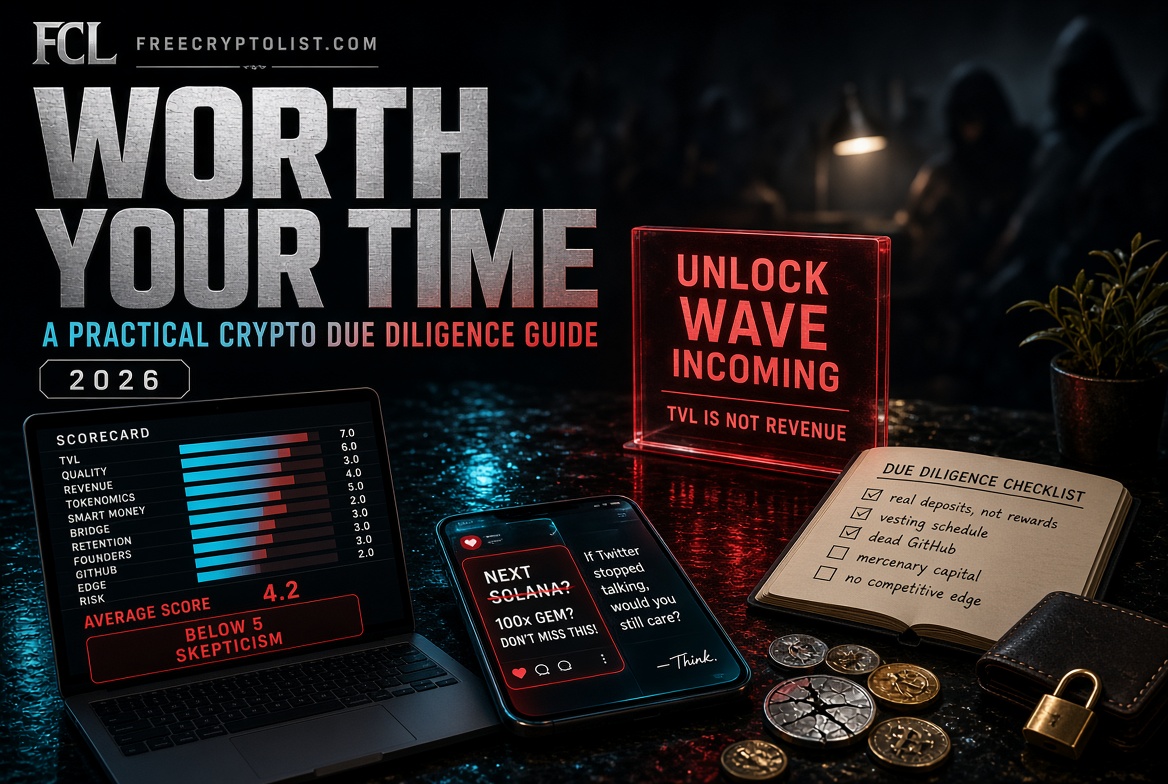
Fill in this table for any project you’re considering. Be honest with each score – for every row, 10 is the best possible result and 1 is the worst – then add up the total. Anything averaging below 5 deserves serious skepticism.
| Factor | Score (1-10, 10 = best) |
|---|---|
| TVL Quality | |
| Revenue Strength | |
| Tokenomics | |
| Smart Money Activity | |
| Founder Quality | |
| User Retention | |
| Competitive Advantage | |
| Developer Activity | |
| Bridge / On-chain Activity | |
| Safety (10 = lowest risk) |
This forces you to think about each factor separately rather than letting one exciting metric override everything else. A project that scores well across most categories is worth serious consideration. A project that scores brilliantly on one thing and poorly on everything else is a red flag – however exciting that one thing might be.
Conclusion
None of this is complicated. It’s just disciplined. In a space where most people make decisions based on trending posts and influencer calls, doing even basic on-chain research puts you ahead of most retail participants.
The goal isn’t to find the perfect project. The goal is to avoid the bad ones – because in crypto, not losing is often more valuable than winning big.
Check every project against these questions before putting money in. If it fails more than a couple of them – no matter how exciting the community makes it sound – walk away. And never put in more than you can afford to lose.
For more on staying safe, see our complete crypto security guide and the real scam DM we dissected – a reminder of why skepticism is your best asset in this space. It’s the same approach we use to rate every opportunity on this site; see how we rate crypto opportunities.
This guide is for education, not financial advice. Always do your own research.
📖 In This Section Rug Pulls · Meme Token Copycats · Complete Security Guide · How We Rate
Start by ruling out a scam: confirm the contract address on the official website and run it through a checker like Token Sniffer or RugCheck. Then look at whether real users pay fees to use the product, how much of the token supply is still locked and when it unlocks, whether users stay after rewards end, who the team is, and whether development is active. Score each factor honestly before deciding.
Not on its own. TVL can be inflated with temporary yield rewards and disappear when they stop, and a 2025 Algorand Foundation study of more than 300 cryptocurrencies found TVL alone was not a meaningful predictor of token returns. What matters more is what’s locked, such as real deposits of stablecoins, ETH, or BTC rather than the project’s own token, and whether the protocol earns real fee revenue.
Token unlocks are scheduled dates when tokens held by the team, investors, or early backers become free to sell. If a large share of the supply unlocks soon, it can create heavy selling pressure even if the project is doing well. Check circulating versus total supply on CoinGecko and upcoming unlock dates on an unlock tracker before buying.
Not automatically, since Bitcoin itself was created pseudonymously. But a team with no public information at all, no track record, no security audit, and no history of delivering on its roadmap deserves serious caution, especially when combined with other warning signs like concentrated token holdings.
DeFiLlama shows TVL, fees, and revenue for most protocols. CoinGecko shows circulating and total supply, and unlock trackers show upcoming token releases. Token Sniffer, GoPlus Security, and RugCheck flag scam contracts, DexScreener shows liquidity and holders, Bubblemaps reveals linked wallets, and a project’s GitHub shows whether development is active.
Sources: