Crypto Task Scams – The Fake “Online Job” That Makes You Pay to Get Paid
Updated October 4, 2026
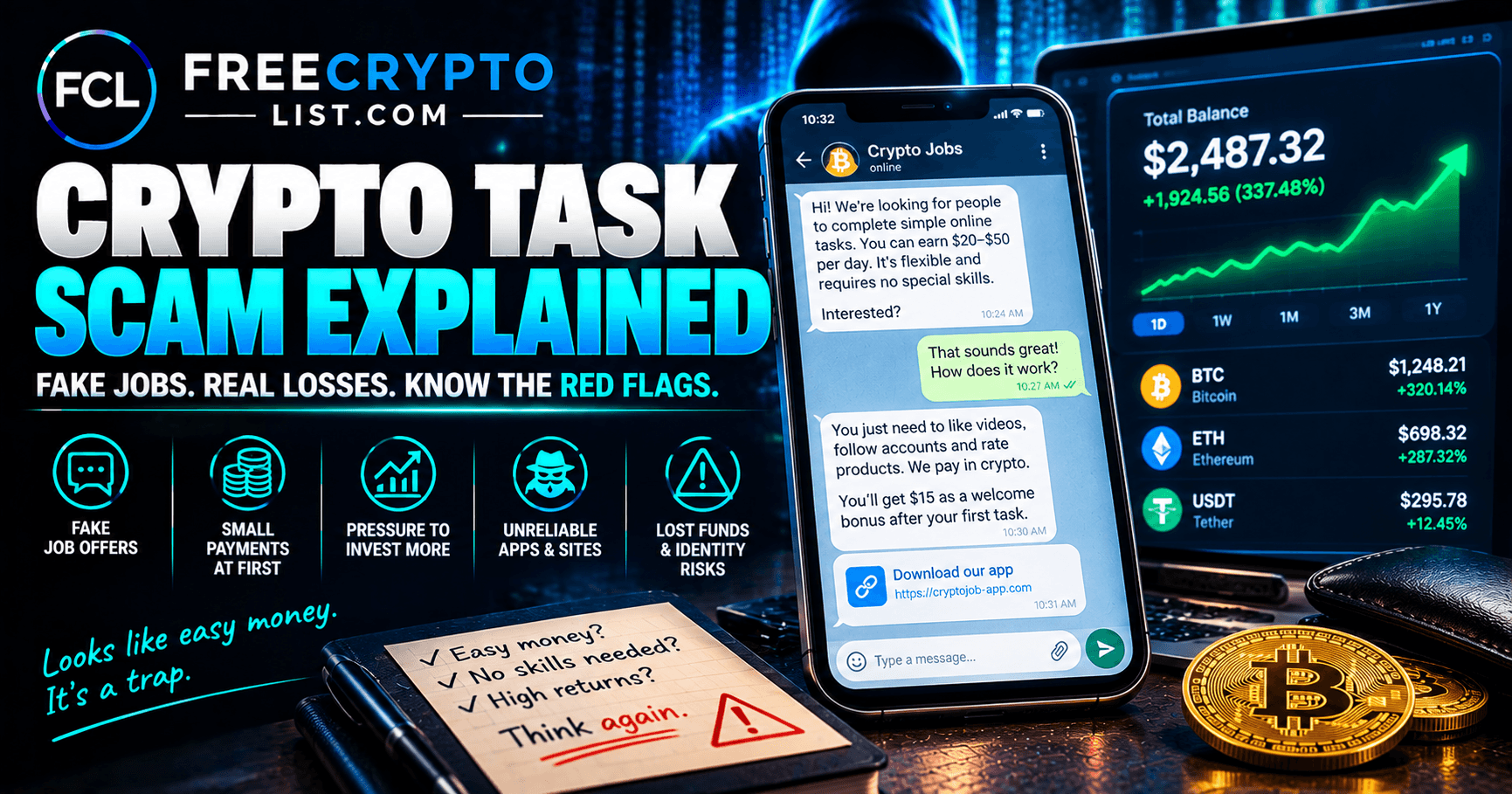
It starts with a friendly text: “Hi, I’m a recruiter. We have a flexible remote job – 30 minutes a day, $200-$800 daily. Interested?”
If you’re the kind of person who reads Free Crypto List, you’re exactly who this message is aimed at. You’re open to earning crypto through small online tasks – surveys, faucets, offers – and you know some of those platforms genuinely pay. Task scammers know that too. They’ve built a fake version of legitimate task earning, with one hidden twist: eventually, you have to pay them.
The short answer: a crypto task scam is a fake online job where you “earn” commissions for simple clicks in an app, get paid a few dollars at first to build trust, and are then required to deposit crypto to unlock bigger earnings or withdraw. The earnings on screen are fake, and every dollar you deposit is gone. No legitimate job or earning platform will ever require you to deposit your own money to get paid.
How Big Is the Problem?
Task scams went from essentially nonexistent to one of the fastest-growing scams in the US in just a few years. According to the Federal Trade Commission, consumer reports about task scams rose from zero in 2020 to about 5,000 in 2023, then quadrupled to roughly 20,000 in just the first half of 2024. Task scams made up nearly 40% of all job scam reports that year, and job scam losses topped $220 million in those six months alone.
Cryptocurrency is the scammers’ payment method of choice. Reported crypto losses to job scams hit about $41 million in the first half of 2024 – nearly double the $21 million reported for all of 2023. And those are only the cases people reported; most victims never do.
How a Crypto Task Scam Works, Step by Step
Step 1: The Unexpected Message
Contact comes out of nowhere – a text, a WhatsApp or Telegram message, or a DM on social media. The sender claims to be a recruiter, sometimes using the name of a real staffing agency or well-known company. The job description is vague on purpose: “app optimization,” “product boosting,” “data rating,” or helping merchants “increase visibility.” Lately, scammers often just ask you to reply “YES” so they know your number is active and you’re interested.
Step 2: The “Easy” Job
You’re onboarded into an app or website and given a “trainer” or “mentor.” The work is simple and repetitive: rate products, like videos, click a button to “boost” an app or hotel listing. Each click shows a commission landing in your account balance. Tasks usually come in sets – often around 40 – and finishing a set promises you’ll “level up” to better pay.
Step 3: Real Money, Just Enough to Hook You
This is what makes task scams so effective: early on, they actually pay you. A small withdrawal of $5 to $20 really does arrive. You’re also added to a group chat full of “coworkers” posting screenshots of big earnings and thanking the mentor. Some of them are scammers; some may be other victims at an earlier stage.
Step 4: The Negative Balance
Then the “combination task,” “lucky order,” or “double task” appears – presented as a bonus with extra-high commission. But completing it pushes your account into a negative balance. To continue, or to withdraw anything you’ve “earned,” you have to top up the account. And the top-up has to be in crypto.
The mentor walks you through it step by step: buy crypto on an exchange like Coinbase, or sometimes at a crypto ATM, and send it to a wallet address they provide. You may be told not to mention the “job” to your bank or the exchange if they ask questions.
Step 5: The Escalation
Each time you top up, another combination task appears, requiring a bigger deposit. Then come the “fees”: a withdrawal fee, a tax, an account verification charge, a penalty for missing a task. Victims who have already sent hundreds or thousands of dollars keep paying because walking away means losing everything they’ve put in. The FBI has warned that scammers even encourage victims to take out loans to cover the “negative balance.”
Eventually, the account freezes or the mentor disappears. The commissions on screen were never real. The deposits went straight to the scammers.
Why It Works on Smart People
Task scams aren’t aimed at gullible people. They’re designed around ordinary psychology:
- The early payouts are real. Once you’ve actually withdrawn money, the platform feels proven.
- It feels like a game. Sets, levels, streaks, and “lucky” bonuses keep you clicking, the same way mobile games do.
- Sunk cost does the rest. After the first deposit, every next deposit feels like the way to get your money back rather than losing more.
- The community looks real. A group chat full of happy “coworkers” makes it feel normal.
Red Flags of a Crypto Task Scam
- You were contacted out of the blue about a job you never applied for, by text, WhatsApp, Telegram, or social media
- The job uses buzzwords like “optimization,” “product boosting,” “data rating,” or “merchant visibility,” with no real description
- You were “hired” instantly – no interview, no references, no paperwork
- Your pay is shown only inside their app, as a balance you can’t fully withdraw
- You’re asked to deposit money – especially crypto – to unlock tasks, clear a negative balance, or withdraw earnings
- The more you deposit, the bigger the promised commission
- You’re told to keep it quiet from your bank or exchange
- Withdrawals keep getting blocked by new fees, taxes, or “verification” charges
If you see the deposit requirement, you don’t need to check the rest. That single sign is enough. As the FBI puts it, no legitimate job opportunity requires you to deposit your own money to perform tasks.
Legitimate Task Sites vs. Task Scams
Real task and survey platforms do exist – we review several on this site – so it helps to know exactly how they differ.
| Legitimate task and survey sites | Crypto task scams | |
|---|---|---|
| How you found it | You looked it up and signed up yourself | Someone messaged you first |
| Cost to start | Free | Free at first, then deposits required |
| What you earn | Small amounts – usually cents to a few dollars per task | Unrealistic promises like $200-$800 a day |
| Withdrawing | Cash out once you reach a stated minimum, no fees to “unlock” it | Withdrawals require deposits, fees, or taxes first |
| Track record | Years of history and public reviews you can check | New or copycat site, reviews are fake or nonexistent |
| Support | Official help desk on the platform’s own website | A personal “mentor” on WhatsApp or Telegram |
For examples of what legitimate task earning actually looks like – including how slowly the money really comes in – see our Cointiply review, PrizeRebel review, and our roundup of the best crypto survey and task sites. Every platform we list is checked against our rating methodology, and none of them will ever ask you to deposit money to get paid.
What To Do If You’re Caught in a Task Scam
- Stop paying – immediately. No deposit, fee, or tax will unlock your balance. The balance isn’t real. Every additional payment is simply more money lost.
- Stop communicating with the “mentor” and leave the group chats. Expect pressure, guilt trips, or threats when you stop; they’re designed to pull you back.
- Save everything. Screenshots of the chats, the app or website address, wallet addresses you sent crypto to, and transaction IDs.
- Tell your bank and the exchange you used. If funds are still moving through a regulated exchange, they can sometimes freeze them.
- Report it. In the US, file reports with the FBI at ic3.gov and the FTC at reportfraud.ftc.gov. If you shared your ID, Social Security number, or bank details during “onboarding,” also visit identitytheft.gov.
- Watch out for the second scam. Victims are often contacted afterward by “recovery experts” or fake law firms who know exactly how much you lost and offer to get it back for a fee. The FBI has specifically warned about these. Legitimate law enforcement never charges you to recover funds.
If you sent crypto from your own wallet and also connected it to any site the scammers provided, check for token approvals too – our wallet drainer approvals guide explains how.
The Bottom Line
Earning crypto through small online tasks is real – it’s what this whole site is about. But real earning platforms pay you, slowly, and never the other way around. The moment a “job” asks you to send money to make money, it’s a scam, no matter how many times it has already paid you, how friendly your mentor is, or how many coworkers in the group chat say it’s legit.
Task scams are a cousin of other social engineering scams we’ve covered. If you want to recognize the whole family, read our breakdowns of pig butchering, which uses the same slow-build trust and fake dashboard, and Discord and Telegram social engineering. And when you’re ready to earn crypto the legitimate way, start with our Earn Free Crypto hub.
A crypto task scam is a fake online job where you earn commissions for simple clicks like rating products or “optimizing” apps. The scammers pay small amounts at first to build trust, then require you to deposit cryptocurrency to unlock more tasks or withdraw your earnings. The balance in the app is fake, and the deposits go straight to the scammers.
The small early payouts, usually $5 to $20, are bait. Once you’ve actually received money, the platform feels proven, which makes you far more likely to deposit when a “combination task” pushes your account into a negative balance. Getting paid once does not make a task platform legitimate.
A combination task, sometimes called a lucky order or double task, is presented as a bonus with extra-high commission. Completing it puts your account into a negative balance, and you’re told you must deposit money, usually crypto, to clear it before you can continue or withdraw. Each deposit tends to trigger another, larger combination task.
Legitimate task and survey sites are free to join, you sign up on your own rather than being recruited by message, they pay small amounts per task, and they let you cash out at a stated minimum without any fee to unlock your money. A task scam contacts you first, promises unrealistic daily earnings, and eventually requires you to deposit money to get paid.
No. In a task scam, the earnings shown in the app don’t exist, so no fee, tax, or verification charge will ever release them. Every extra payment is more money lost. Stop paying, save your records, and report it.
In the US, report it to the FBI at ic3.gov and to the FTC at reportfraud.ftc.gov, and tell your bank and the exchange you used. If you shared ID or banking details, also visit identitytheft.gov. Be wary of anyone who contacts you afterward offering to recover your money for a fee, which is a common follow-up scam.
Sources
- FTC – New FTC Data Show Skyrocketing Consumer Reports About Game-Like Online Job Scams (Dec 2024)
- FTC Data Spotlight – Paying to Get Paid: Gamified Job Scams Drive Record Losses
- FTC Consumer Alert – How to Spot and Avoid Task Scams (Aug 2025)
- FTC Consumer Alert – That Job Offer Text Is Probably a Scam (Apr 2026)
- FBI – Cryptocurrency Job Scams
- FBI IC3 – Scammers Defraud Individuals via Work-From-Home Scams (Jun 2024)
- Decrypt – Fake Law Firms Targeting Crypto Scam Victims, FBI Warns (Aug 2025)
📖 In This Section Pig Butchering · Discord & Telegram Scams · Complete Security Guide