Crypto Pump and Dump Schemes – How Telegram Groups Are Coordinating Token Manipulation in 2026
Updated October 4, 2026
I lost money on this one deliberately. Not much – 0.25 SOL – but enough to document exactly what happens inside a crypto pump and dump scheme, from the moment the invitation arrives to the moment there’s nothing left to sell into.
This article is that documentation. Real screenshots, real tokens, real losses.
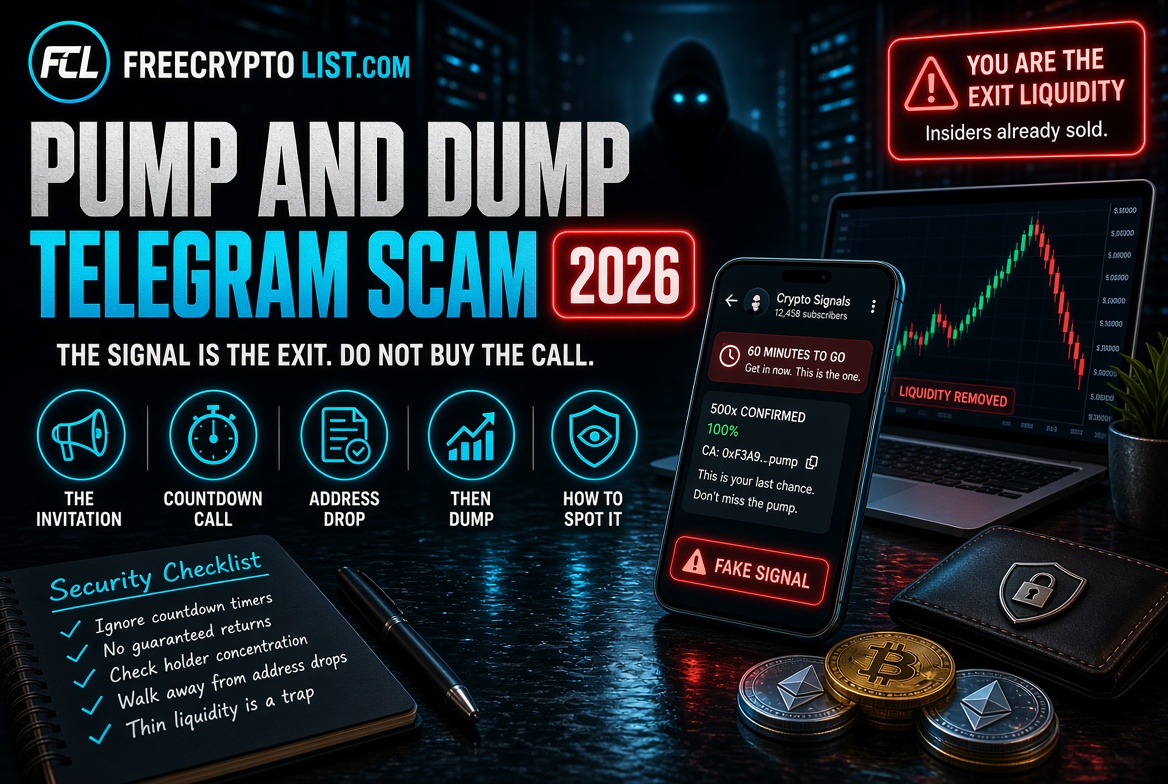
The short version: a crypto pump and dump is a coordinated scheme where an organizer buys a tiny, illiquid token first, then tells a large group to buy it at the same moment. The rush pushes the price up for a few minutes, the organizer sells into that buying, and almost everyone else is left holding a token that has collapsed. The group is the organizer’s exit. Here’s exactly how it works.
How It Starts – The Invitation
It starts on social media. In my case it was X – a direct message inviting me to join a Telegram channel dedicated to “crypto signals.” The same recruitment happens on Facebook, Instagram, TikTok, and Threads. The message is always some version of: join this channel, we share winning trades, completely free.
The channel I joined had 4,100 subscribers. That number matters – it’s large enough to feel legitimate, and small enough that members’ buying can meaningfully move a micro-cap token’s price.
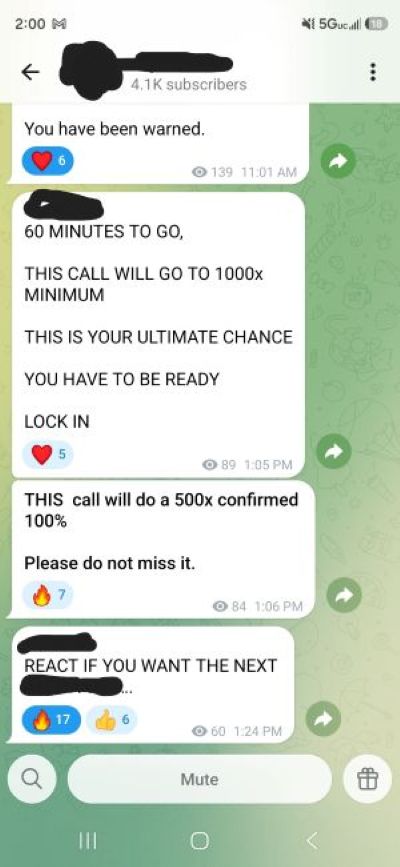
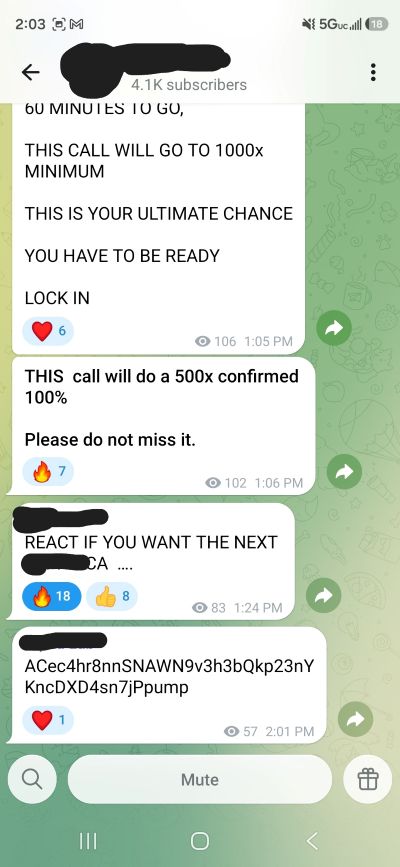
Once inside, the channel is mostly quiet. Occasional posts build anticipation. Then, as a new “call” approaches, the messages start:
“60 MINUTES TO GO” “THIS CALL WILL GO TO 1000x MINIMUM” “THIS IS YOUR ULTIMATE CHANCE” “YOU HAVE BEEN WARNED” “THIS call will do a 500x confirmed 100%”
Every element of this language is engineered. The countdown creates urgency. “1000x minimum” and “500x confirmed 100%” are absurd claims that would be laughable anywhere else – but in the moment, surrounded by fire emojis and heart reactions from other members, the social proof makes them feel believable.
Then, at the designated time, the organizer posts a contract address.
Not a token name. Not a ticker symbol. A raw Solana contract address.
Why an Address and Not a Name
This detail is worth understanding.
Pump.fun – the platform most of these tokens launch on – lets anyone create a token with any name in minutes for a tiny fee. There are often dozens of tokens with identical or similar names trading at the same time. If the organizer posted “buy FIFA2026,” members would scatter across several different tokens, diluting the buying pressure.
By posting one exact contract address – in the FIFA case, ACec4hr8nnSNAWN9v3h3bQkp23nYKncDXD4sn7jPpump – every buyer is sent to exactly the same token. That concentrated buying is what creates the spike. Without coordination on the exact address, there is no pump.
The “pump” ending on that address is literal – pump.fun token addresses end that way, which tells you where it was created.
What Is Pump.fun and the Bonding Curve?
Pump.fun is a Solana token launchpad that lets anyone create a meme token in minutes with no coding required. It’s a real platform, not a scam in itself.
The bonding curve is pump.fun’s pricing mechanism. A new token starts at a very low price. As people buy, the price rises automatically along a mathematical curve – the first buyers get the lowest prices, and every purchase after that pushes the price higher. Selling moves it back down the same curve.
When a token’s bonding curve fills up – roughly $69,000 in market cap, or about 85 SOL in the curve – it “graduates.” Since March 2025, graduated tokens move to PumpSwap, pump.fun’s own decentralized exchange. (Before that, they migrated to Raydium, a separate Solana exchange, which is why many older guides still mention it.)
Pump and dump organizers exploit this in two ways:
Pre-graduation pumps – the organizer launches a token or finds one that just launched, buys heavily near the bottom of the curve, then signals the channel. Members’ buying pushes the price up the curve. The organizer sells near the top, and the price slides right back down.
Post-graduation pumps – the token has already graduated but still has a tiny market cap and thin liquidity. The same concentrated buying moves the price dramatically, and the same reversal follows when the organizer sells.
Either way, the organizer is selling into buying pressure created by their own channel members.
The FIFA26 Pump – Documented
The second pump I documented was a token called FIFA World Cup 2026 – ticker FIFA26 – on pump.fun. This time I recorded the price action without buying.
When the signal went out, the token’s market cap was about $4,000. The coordinated buying pushed it to an all-time high of about $9,900 – roughly 2.5x in minutes.
By 2:17 PM, 16 minutes after the address was posted, the market cap had already fallen to about $3,100 – nearly 70% below the peak.
By 2:30 PM it was down to $2,776 – a 72% drop from the all-time high in under 30 minutes.
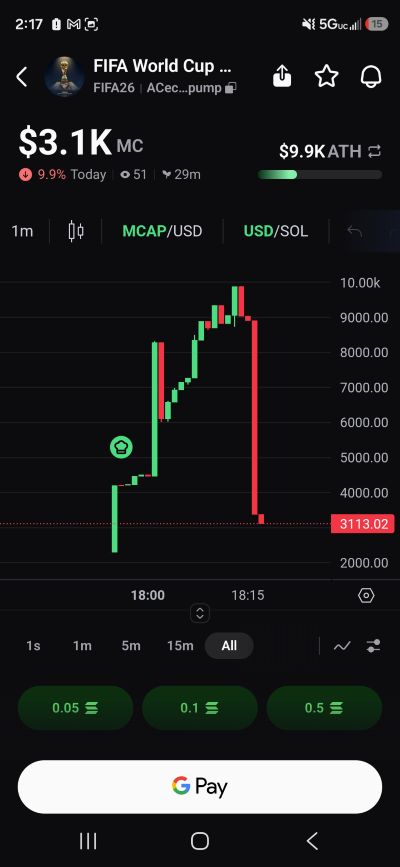
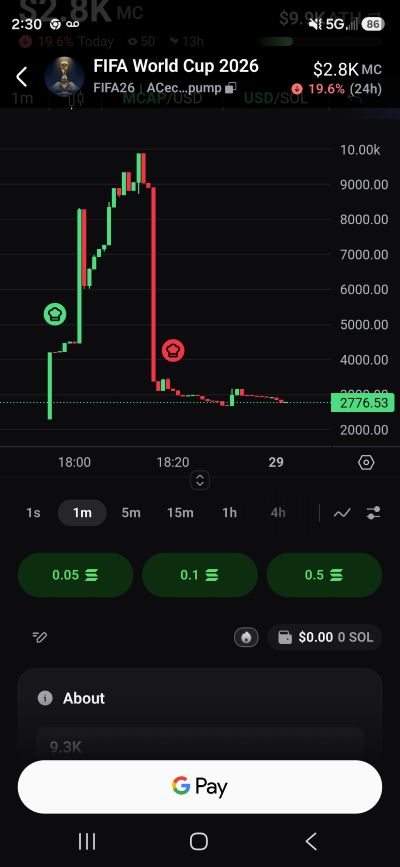
The chart tells the whole story: a near-vertical green candle up, then an equally vertical red candle down. That’s the textbook pump and dump pattern. Anyone who bought after the first minute or two lost most of their money within half an hour.
The TROLLY Position – What Happened to My Money
The first pump I bought into was a token called TROLLY on Solana.
I put in 0.25 SOL – about $35-40 at the time – and received 2,576,009 TROLLY tokens.
When I tried to sell after the price started falling, my wallet showed: “No liquidity found – Unable to find a market for this swap.”
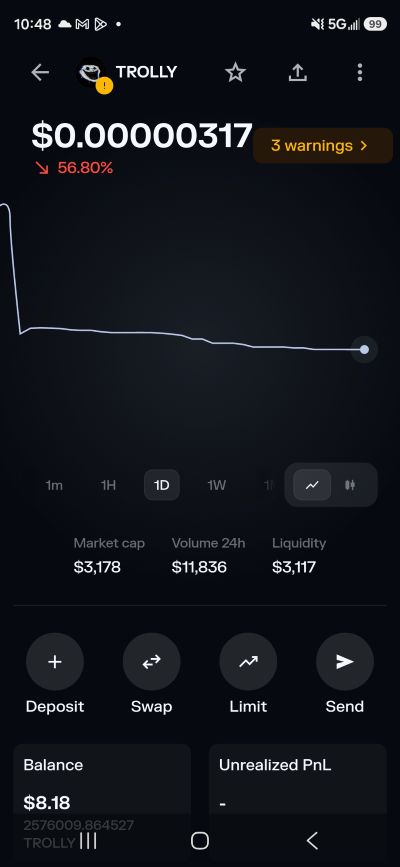
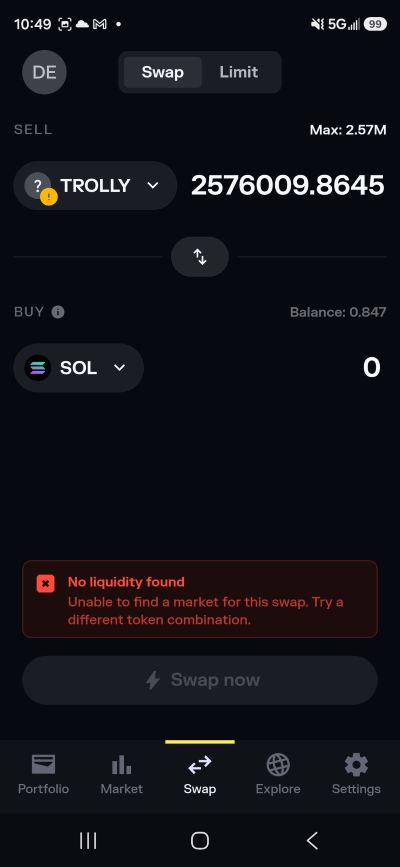
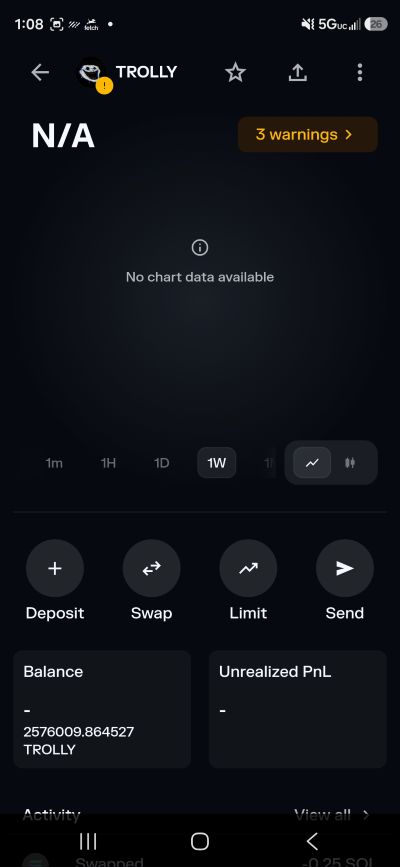
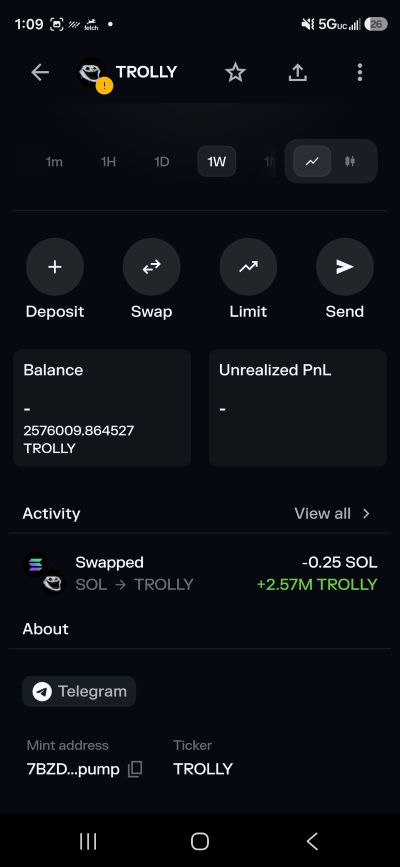
There was nothing left to sell into. My 2.57 million TROLLY tokens were worth about $8.18 on paper at that point – a loss of roughly 80% – and I couldn’t sell them at all.
How liquidity disappears depends on where a token trades. On platforms where the token’s creator controls the trading pool, they can simply pull the liquidity out – a classic rug pull that leaves every holder stuck. On pump.fun’s bonding curve, the creator can’t remove liquidity, because the curve contract itself holds it – but organizers can still dump their tokens so hard that what’s left is close to worthless. Either way, the result for the people who bought late is the same.
This is the pump and dump completing its full cycle. The organizer:
- Created or picked the token
- Bought in early at the lowest price
- Signaled the channel to buy
- Sold into the buying pressure as the price rose
- Left the remaining holders with a collapsed price – or no market at all
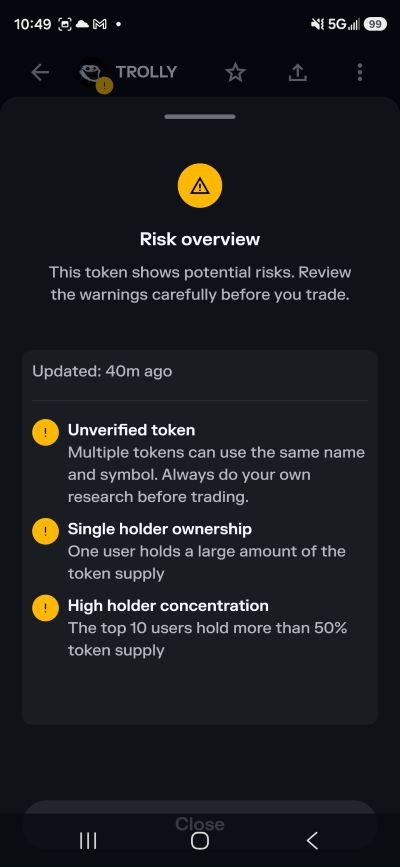
My wallet’s risk detection flagged three warnings on TROLLY before I bought. I saw them and bought anyway, because I was going to document the process:
- Unverified token – multiple tokens can use the same name and symbol
- Single holder ownership – one user holds a large amount of the token supply
- High holder concentration – the top 10 users hold more than 50% of the token supply
That last warning is the most important. When the top 10 holders control more than half the supply – and one of them is the organizer who is about to sell into your buying – the outcome is decided before you click buy.
The Red Flags That Were Visible Before the Pump
Looking back at what I could see before buying, every warning sign was there:
The language in the channel. “500x confirmed 100%” and “1000x MINIMUM” are not how legitimate investment analysis is communicated. No return is ever “confirmed.” Anyone making these claims is either lying or delusional – and pump organizers aren’t delusional.
The countdown timer. Real opportunities don’t expire in 60 minutes. The countdown exists to stop you from thinking. If something is truly certain, why does it need a timer?
The address instead of a name. Legitimate projects have names, websites, social accounts, and documentation. They want you to research them. A pump organizer wants you to buy before you research anything.
The wallet warnings. Single-holder and high-concentration warnings are visible before you buy in most Solana wallets. They exist for exactly this reason: a handful of wallets can move the price at will.
The market cap. Both tokens were under $10,000 in market cap when the signal went out. That isn’t undiscovered value – it’s a token with almost no liquidity, where a few hundred dollars can move the price dramatically in either direction. Thin liquidity is the mechanism the pump needs.
Who Makes Money and Who Loses
A pump and dump is zero-sum – every dollar someone wins is a dollar someone else loses.
The organizer makes money. They bought early, sold at the peak, and left everyone else holding the bag. Their profit comes straight from the losses of members who bought near the top.
The earliest members sometimes make money – if they buy instantly and sell before the peak. These occasional winners are the social proof that keeps the channel alive. Organizers encourage winners to post their gains. Losers tend not to post.
The majority of members lose. The spike lasts minutes. Most buyers simply aren’t fast enough to get out before the organizer does – and often bots buy and sell faster than any human can.
The organizer uses their own channel as exit liquidity.
This isn’t limited to one channel. When blockchain analytics firm Solidus Labs studied pump.fun in 2025, it classified about 98.6% of the roughly 7 million tokens launched there since January 2024 as rug pulls or pump-and-dump schemes; only about 97,000 still had at least $1,000 in liquidity. Pump.fun disputed the findings, arguing that most meme tokens naturally end up with little value. Either way, the odds of picking a winner from a random pump.fun token are extremely poor.
What “Graduated” Means and Why It Matters
When a pump.fun token graduates – fills its bonding curve and moves to PumpSwap – it picks up a certain legitimacy signal. Some traders specifically hunt for freshly graduated tokens.
Pump organizers exploit this by timing signals around graduation or targeting newly graduated tokens that still have thin liquidity. The graduation attracts genuine buyers, who provide even more exit liquidity for the organizer.
Knowing this helps you tell organic movement from coordinated movement. A token that graduates with steady buying over hours looks very different on a chart from one that spikes vertically minutes after a Telegram signal.
How to Recognize a Pump in Progress
On Telegram or other channels:
- Countdown timers to a “call” or “signal”
- Guaranteed return language – any percentage described as “confirmed” or “minimum”
- Contract address drops instead of token names
- Fire emojis, urgency language, and pressure to react or confirm participation
- Requests to react if you want the next call – engagement farming to find active members
On the token itself:
- Tiny market cap – under $50,000
- Single-holder or high-concentration warnings in your wallet
- No verifiable project, team, or use case
- A vertical price spike on the 1-minute chart that lines up with the signal time
Using free tools:
- DexScreener – check the liquidity amount (under $5,000 means a few hundred dollars of selling can crash the price), the holders list, and the transaction history for bursts of coordinated buying
- RugCheck – flags concentrated holdings and other risk factors on Solana tokens
- Bubblemaps – shows whether the top holders are secretly linked wallets controlled by the same person
Our rug pull guide walks through using these tools step by step.
Is Pump.fun a Scam?
No – but this distinction needs to be honest.
Pump.fun itself is a functioning token launchpad with transparent mechanics, and some meme tokens launched there have built real communities. The pump and dump scheme uses pump.fun as infrastructure, the same way a scammer might use a legitimate bank’s wire transfer system. The tool isn’t the scam. The coordinated manipulation is.
At the same time, the numbers above show what the platform mostly produces: an endless stream of tokens that go to zero. Treat anything you find there as a lottery ticket at best – and anything promoted in a “signals” channel as a trap.
Understanding pump.fun’s mechanics – especially the bonding curve and graduation – helps you evaluate meme tokens more clearly, whether you’re curious about them or just trying to recognize a pump in progress. For how copycat tokens flood in around big launches, see how meme tokens front-run chain launches.
Signal or Noise? 🔴 Noise – coordinated pump and dump groups are not trading communities. They are extraction machines where the organizer profits from members’ losses. The occasional winner provides cover for consistent losses across the majority. The only reliable beneficiary is the person running the channel.
What To Do If You’re Already in a Position
If you bought into a pump and now can’t sell, or can only sell for almost nothing:
- Don’t add more money trying to average down – the price collapse is intentional
- Check back occasionally – sometimes a little liquidity returns briefly and a small exit is possible
- Accept the loss and treat it as an expensive lesson – the time spent chasing it usually costs more than the tokens are worth
- Never pay anyone to “recover” or “unlock” your tokens – those offers are a second scam, and connecting your wallet to an “unlock” site can expose everything else you hold (see our wallet drainer approvals guide)
- Report the channel using Telegram’s report function
The social engineering behind these channels is covered in more depth in our Discord and Telegram social engineering guide, and the related trick of tokens you can’t sell at all is explained in honeypot tokens.
📖 In This Section Meme Tokens Front-Running Launches · Honeypot Tokens · Rug Pulls · Discord & Telegram Scams
A crypto pump and dump is a coordinated scheme where an organizer buys a small, illiquid token first, then tells a large group to buy it at the same moment. The rush briefly pushes the price up, the organizer sells into that buying, and the price collapses, leaving most group members with heavy losses.
Groups that post countdowns, “confirmed” or “minimum” returns, and raw contract addresses to buy at a set time are pump and dump operations, not trading communities. The organizer profits by selling to the members. Any group promising guaranteed returns on a specific token should be treated as a scam.
Pump.fun itself is a working token launchpad, not a scam, but most tokens launched there fail. A 2025 Solidus Labs report classified about 98.6% of pump.fun tokens as rug pulls or pump and dumps, a finding pump.fun disputed. Pump and dump groups use it because anyone can launch a token in minutes for a tiny fee.
A token graduates when its bonding curve fills up, at roughly $69,000 in market cap or about 85 SOL in the curve. Since March 2025, graduated tokens move to PumpSwap, pump.fun’s own exchange, instead of Raydium. Graduation is not a sign of quality, and pump groups often target freshly graduated tokens that still have thin liquidity.
It means there is no market able to buy your tokens. Either the token’s creator removed the liquidity pool, which is possible on platforms where they control it, or the price has been dumped so hard that almost nothing is left to sell into. Don’t buy more, never pay anyone to unlock the tokens, and check back occasionally in case a small exit appears.
Check the liquidity and holder list on DexScreener, run the address through RugCheck for Solana risk flags, and use Bubblemaps to see whether the top holders are linked wallets. Heed your wallet’s warnings about single-holder ownership or high holder concentration. A tiny market cap with a few wallets holding most of the supply is a setup for a dump.
Sources: