The FIRE Mechanism Is Live – What FIP.16 Actually Changed for Flare and XRPFi Holders
Updated October 10, 2026
In July 2026, Flare announced that its FIRE mechanism had switched on and that fees had started flowing into it. It’s the kind of announcement that sounds big but is hard to decode if you’re not deep in the Flare ecosystem.
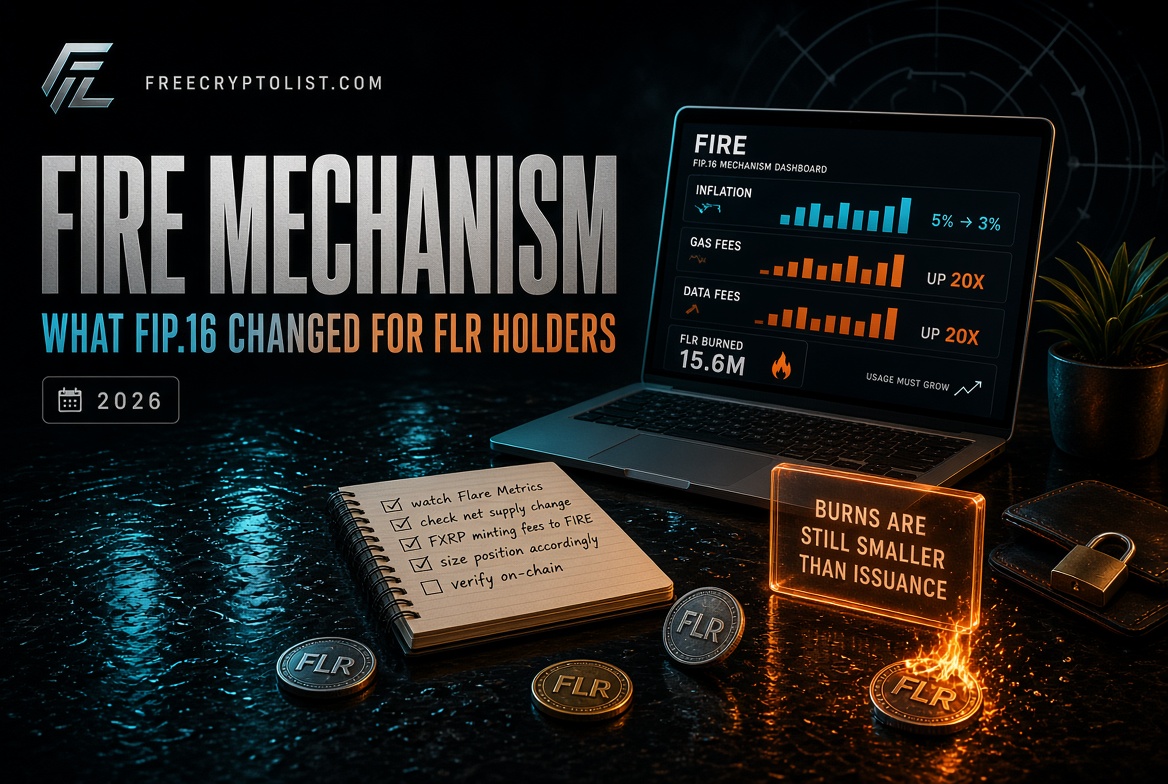
The short version: FIRE (the Flare Income Reinvestment Entity) collects revenue that the Flare network earns, mainly from FXRP minting and data requests, and uses it mostly to burn and buy back FLR. Together with an inflation cut and a 20x gas fee increase under the FIP.16 proposal, it’s meant to tie FLR’s value to real network use. It’s working as designed, but so far the numbers are small: about $31,000 collected by FIRE and 15.6 million FLR burned in 2026 as of early September, against about 2.6 billion new FLR issued each year. Whether it ever makes FLR shrink in supply depends entirely on usage growing a lot.
This article explains what changed, what it means for FLR and FXRP holders, and what to watch. It’s the third in our Flare series. If you’re new, start with Flare XRPFi Explained and XRPFi Flywheel Step 2.
The Problem FIP.16 Was Designed to Fix
For most of Flare’s first years, FLR had a structural problem. The network was growing: FAssets launched, FXRP minting took off, and DeFi apps started building on Flare. But very little of that activity flowed back to FLR holders. Usage grew. The token didn’t capture it.
The reason was that Flare’s economics were still in bootstrapping mode. High inflation, 5% a year, handed out new tokens constantly to reward participation, and much of that turned into steady selling. Meanwhile, the fees from network activity were small, and burns were tiny: about 7.5 million FLR over six months, according to Flare.
FIP.16, published by Flare on April 8, 2026 and passed by governance on April 24 with about 98% of votes in favor, was designed to fix this. The core idea: link FLR’s value to how much the network is actually used, rather than to inflation schedules and airdrops.
What FIP.16 Changed
The changes rolled out in stages through mid-2026:
May 14, 2026 – Inflation cut. Annual FLR issuance dropped from 5% to 3%, and the yearly cap on new tokens fell from 5 billion to 3 billion FLR. On an inflatable supply of about 87 billion FLR, that works out to roughly 2.6 billion new FLR a year. The base used for the inflation calculation also shrank: burned tokens, unearned rewards, and FLR held by FIRE no longer count.
July 14, 2026 – Gas fees up 20x. A network hard fork raised the minimum gas price from 25 to 500 gwei. That sounds dramatic, but a simple transfer still costs only about 0.064 FLR, a tiny fraction of a cent. Base transaction fees are burned, so more activity now means more FLR permanently removed. The same upgrade raised the maximum validator size from 200 million to 300 million FLR. (For how gas fees work in general, see our gas fees guide.)
Data request fees up 20x. Base fees for most Flare Data Connector requests rose from 1 FLR to 20 FLR, with 90% of them going to FIRE.
Staking favored over delegation. FLR staked on Flare’s P-chain now counts five times as much as delegated WFLR, and a 20% minimum fee for data providers applies across the network. More on what that means for your rewards below.
Flare projected that the fee changes would burn about 300 million FLR a year at the time’s activity levels. As you’ll see, the real numbers so far are far lower.
What Is FIRE?
FIRE stands for Flare Income Reinvestment Entity. It’s a governed pool that collects protocol revenue from across the Flare ecosystem and puts it to work.
Where FIRE’s money comes from (live now):
- FAssets minting fees – all of them. Every time someone mints FXRP, the minting fee goes to FIRE. This is FIRE’s biggest source so far
- Flare Data Connector fees – 90% of data request fees, with the other 10% going to the existing rewards path
- FAssets redemption fees – 10% of them
- FXRP destination-tag registration fees, paid in FLR
Note that ordinary gas fees don’t go to FIRE. They’re burned directly.
Planned for later:
- MEV capture – profit from things like liquidations and arbitrage that currently goes to outside players. Flare plans to capture it in stages, starting with a designated block builder and later moving block building into Flare Confidential Compute. As of September 2026, MEV capture wasn’t live yet
- Flare Confidential Compute and Smart Account fees, once those products are running
What FIRE does with the money: its main job is to reduce FLR supply through burns and open-market buybacks. Its secondary jobs are rewarding asset issuers, supporting yield and liquidity in Flare apps, and funding the Flare Foundation’s work. Its first planned use is paying validator and staker rewards from real revenue instead of new inflation. Flare says those rewards would come “in place of, not in addition to” inflation-based rewards, with the aim of pushing effective inflation below 3%.
Who controls it: the Flare Foundation runs FIRE at first. After a year, the community can vote to move it to joint governance, but that takes at least 50% of the total inflatable FLR supply voting in favor.
Is It Working? The Real Numbers
This is where honesty matters. According to DefiLlama’s research team, as of early September 2026:
- FIRE had collected about $31,438 since May, including about $18,248 from FAssets minting fees and about $12,676 from data requests
- About 15.6 million FLR had been burned through transaction fees in 2026, with more than 40% of that after the July 14 fee increase
- The burn rate after the fork was more than 10x the earlier baseline
So yes, the mechanism works: fees are flowing, and burns have sped up sharply. But compare that to roughly 2.6 billion FLR issued each year. Burns are running at a small fraction of a percent of new issuance, far below the 300 million FLR a year Flare projected. FLR is still an inflationary token, and will stay that way unless network activity grows many times over.
What This Means If You Hold FLR
Before FIP.16, holding FLR meant accepting about 5% yearly dilution, with almost nothing offsetting it. After FIP.16:
- Issuance is capped at 3% a year, still positive but meaningfully lower
- Every transaction burns more FLR than before, and burns grow with usage
- FIRE’s buybacks and burns are tied directly to network revenue
- In theory, net supply could shrink if usage grows enough. In practice, that’s a long way off
About your delegation rewards: if you delegate WFLR, for example through Bifrost Wallet, your rewards keep coming, but they did change. Less new FLR is issued, so there’s less to share out. Staked FLR now carries five times the weight of delegated WFLR. And every data provider now charges at least a 20% fee. Holders have noticed: staked FLR rose from about 16 billion in July to about 21.5 billion by late August. If you hold 50,000 FLR or more, P-chain staking with a validator may now pay better than delegation, in exchange for a fixed lockup. Our guide to choosing a validator covers what to look for. Either way, check current rates on Flare Metrics rather than relying on older figures, including ours.
What This Means If You Hold FXRP or stXRP
FIRE matters for FXRP holders too, just differently.
Every FXRP mint pays a fee that goes to FIRE, and part of every redemption fee does too. That ties XRPFi activity directly to FLR’s economics. If more XRP flows into Flare, FIRE collects more. It doesn’t change what you earn on FXRP itself.
For stXRP holders on Firelight, the more important development is Firelight Phase 2. In Phase 2, DeFi protocols pay Firelight for on-chain cover against hacks, and those fees become rewards for stXRP holders. That’s separate from FIRE: FIRE captures network-level value for FLR, while Phase 2 is meant to pay XRP stakers. Phase 2 also brings slashing risk, meaning stakers can lose part of their FXRP if a covered protocol is hacked. As of Firelight’s July 2026 update, Phase 2 was still being prepared. Check the Firelight app for current status.
What’s Next
Flare Confidential Compute (FCC) on Songbird – approved. The vote on proposal STP.13 ran July 6-12, 2026, and the proposal was accepted. FCC uses Trusted Execution Environments, secure hardware zones, to run sensitive code and keys. Its first uses are an upgraded Flare Data Connector (FDC v2) and Protocol Managed Wallets, which let apps control wallets on other blockchains, starting with the XRP Ledger, under protocol rules rather than a central custodian. It’s the first piece of the “Flare 2.0” design, deployed first on Songbird, Flare’s live canary network. No mainnet date has been given.
MEV capture – planned. Staged rollout, not yet live as of September. When it arrives, it becomes another revenue source for FIRE.
BTC as an FAsset – no firm date. Flare says Bitcoin is next on the same FAssets system used for FXRP. If it launches, Bitcoin holders could bring BTC into Flare DeFi, which would add a lot of potential minting fees for FIRE.
Firelight Phase 2 – no firm date. Real staking rewards for stXRP holders, with real risk attached.
What to Watch On-Chain
The honest way to tell whether FIRE is working is data, not announcements.
- Flare Metrics – delegation performance, provider rewards, and network data
- DefiLlama – independent TVL tracking for Flare, plus the research report on FIP.16 we’ve drawn on here
Key numbers to watch:
- FXRP supply. About 145 million FXRP had been minted by FXRP’s first anniversary in September 2026, down from a peak above 155 million earlier in the year. Mints and redemptions both pay fees, but steady growth in supply is the sign that capital is staying
- FIRE’s running total. It was about $31,000 in early September. A real takeoff would show up here first
- Daily transactions. More transactions mean more burned gas fees
- Net FLR supply change. Issuance minus burns and buybacks: the final scorecard for whether the deflation story is coming true
The Honest Assessment
FIP.16 and FIRE are a real structural improvement in how Flare captures value from its own network. The design makes sense, the changes are live, and fees really are flowing.
The honest caveat is the same one that applies to every well-designed mechanism in crypto: it only works if usage shows up. Right now, FIRE’s revenue and the fee burn are small next to annual issuance. For FLR to become deflationary, XRPFi adoption would need to grow many times over, large XRP holders would need to mint FXRP at scale, and Flare’s data products would need real outside demand.
Those aren’t guaranteed. They’re bets on execution, which is why we always say: size your position accordingly, check the on-chain numbers yourself, and don’t rely on announcements alone. And remember that FLR rewards, from delegation or staking, are generally taxable income in the US. Our guide to crypto tax on free earnings explains the basics.
The flywheel lit up. Whether it ever builds real speed depends on what comes next.
Track the ecosystem:
- Flare Metrics – delegation and network data
- Kinetic – FXRP lending on Flare
- SparkDEX – DEX liquidity for FXRP pairs
- BlazeSwap – another DEX with liquidity pools
- Firelight – stXRP and Phase 2 updates
- Bifrost Wallet – FLR delegation, FXRP minting and management
For informational purposes only. Not financial advice. Always verify URLs before connecting your wallet. Read our Flare scam guide before interacting with any site claiming to be Flare-related, and learn what you’re really signing before approving anything.
FIRE, the Flare Income Reinvestment Entity, is a governed pool that collects revenue the Flare network earns, mainly FXRP minting fees and data request fees. Its main job is to reduce FLR supply through burns and buybacks. It was created by the FIP.16 proposal in 2026.
FIP.16, passed on April 24, 2026, cut FLR’s yearly issuance from 5% to 3% starting May 14, raised the minimum gas price 20x from 25 to 500 gwei with a July 14 hard fork, raised data request fees, created FIRE, and gave staked FLR five times the weight of delegated WFLR.
No. About 2.6 billion new FLR are still issued each year, while about 15.6 million FLR had been burned in 2026 as of early September. Burns have sped up sharply since July, but FLR would only become deflationary if network usage grew many times over.
According to DefiLlama’s research team, FIRE had collected about $31,438 by early September 2026, including about $18,248 from FAssets minting fees and about $12,676 from Flare Data Connector requests. MEV capture, another planned revenue source, was not live yet.
Yes. Delegation rewards continue, but less new FLR is issued, staked FLR on the P-chain now counts five times as much as delegated WFLR, and data providers must charge at least a 20% fee. Check current rates on Flare Metrics before deciding between delegating and staking.
Every FXRP mint pays a fee that goes to FIRE, and part of every redemption fee does too, so XRPFi activity feeds FLR’s economics. It doesn’t change what you earn on FXRP itself. Rewards for stXRP holders depend on Firelight’s Phase 2, which is separate from FIRE.
Sources
- Flare Network – From activity to value accrual: our plan for FLR (Apr 2026)
- DefiLlama Research – Flare’s tokenomics revamp (Sep 2026)
- U.Today – Flare tokenomics overhaul: what changed after FIP.16 (Sep 2026)
- Flare Proposals – STP.13: Introduce Flare Confidential Compute
- Blockster – Flare Confidential Compute on Songbird (Jun 2026)
- Firelight – Everything stakers need to know about Phase 2 (Jul 2026)
- KuCoin News – 145M FXRP minted on Flare (Sep 2026)
- Flare Network – FAssets
📖 In This Series Flare XRPFi Explained · XRPFi Flywheel Step 2 · Fake Flare XRP Airdrop Scam · The Compounding Flywheel